Overview
Kinosaki does not have an off season so much as a headline season and several quietly excellent understudies. The headline is winter, and unusually, it is driven less by snow than by dinner: the Matsuba crab is the event the whole regional calendar bends around. The right month for you depends on whether that dinner is the point of your trip, an agreeable bonus, or an expensive distraction from the baths. This guide takes the year season by season, with the honest booking math for each. Two calendars govern the choice, and this guide keeps them separate. The first is the year — crab, blossom, festivals, foliage — which sets what the town is serving and what it charges. The second is the week — the staggered bath-closure rota and the daily tide of day visitors leaving at dusk — which sets what your particular days actually feel like on the street. Most planning advice obsesses over the first and ignores the second; in a town where roughly 85 percent of visitors sleep over and the whole evening belongs to them, the week-level calendar is where good trips are actually won. Read the seasons below for the what, and the two calendar sections further down for the when-exactly. And hold one constant across all of it: the baths, the pass, the yukata and the lantern circuit work identically in every month — Kinosaki has no closed season, only a sliding price on the same ritual. One date to memorise before any of it: November 6, the crab opening, the hinge on which the whole pricing year turns.
Winter (November to March): the crab defines everything
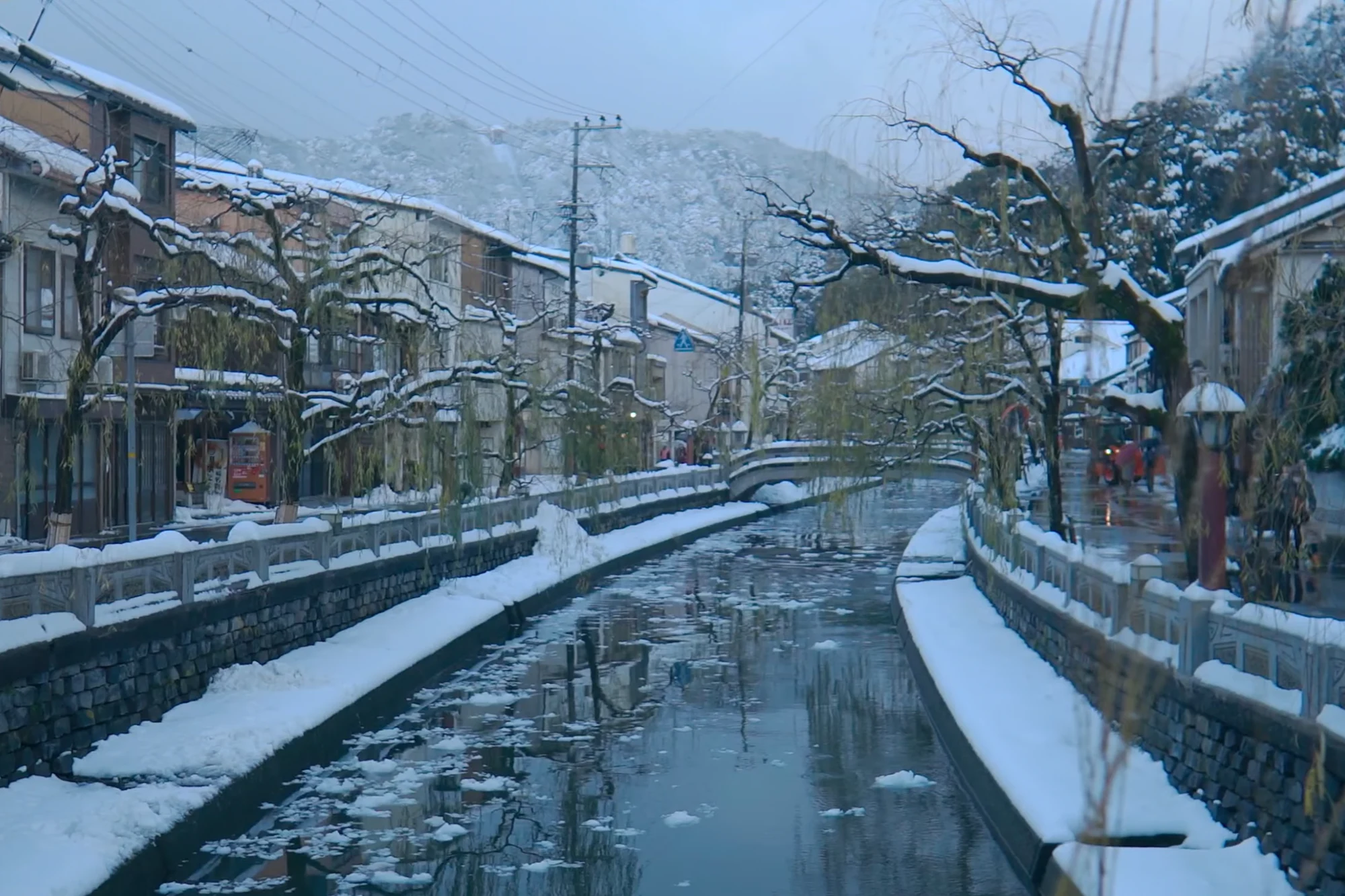
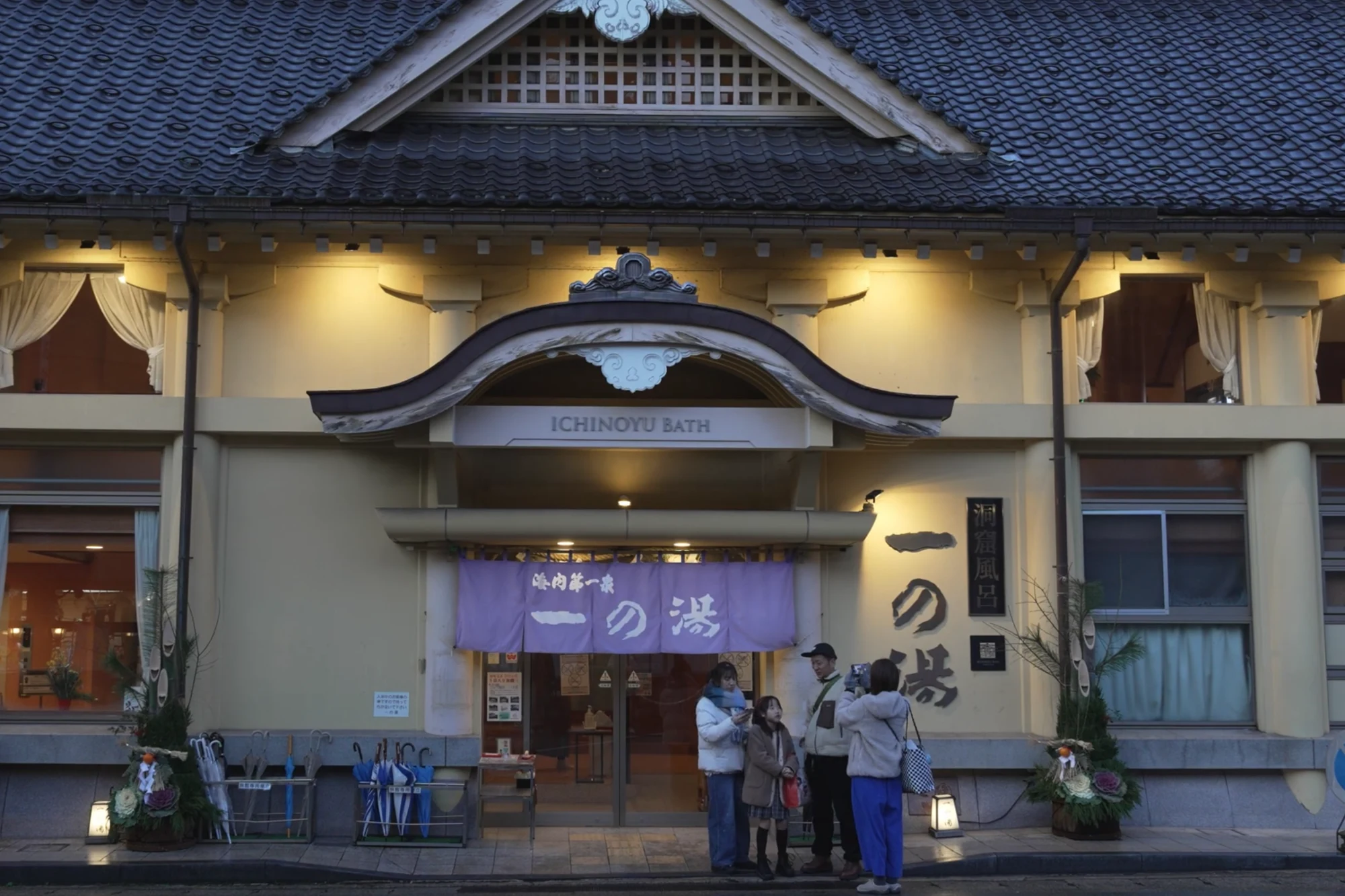
On the open of crab season in early November, Kinosaki changes character. The San'in coast's Matsuba-gani (松葉ガニ), the prized local snow crab, lands at nearby ports, the tagged claws appear in inn kitchens, and ryokan dinners across every price tier reorganize around it: crab sashimi, grilled crab, boiled crab, crab hotpot, a full kaiseki that justifies the year's highest rates by itself. Pair that dinner with the bathhouse circuit in genuine cold, steam thickening over Goshono-yu's waterfall bath, the tanzen (丹前) coat over your yukata, occasionally snow settling on the willows, and you have the version of Kinosaki that fills the posters and the bookings. The practical notes: weekends from late November through February sell out three to six months ahead at the famous houses, the New Year week (roughly December 29 to January 3) is the single most expensive and crowded stretch, and crab pushes dinner-inclusive prices up sharply across the board. ⚠️ verify current season dates. Snow is intermittent rather than guaranteed at sea level; cold is reliable, which is what the baths actually need. Midweek in late January or February gets the full winter at a meaningful discount, and our where to stay guide covers which kitchens take the crab most seriously. One winter-specific habit repays the premium: book dinner for the earliest sitting your inn offers. Crab kaiseki runs long, the bathhouses close at 23:00 (11 pm) with last entry half an hour before, and the difference between an 18:00 and a 19:30 sitting is one entire house on the evening circuit. And if snow does come, drop the schedule and take the nearest open bath immediately — snowfall over an outdoor tub is the single luckiest hour the town can deal you, and it rarely lasts the night.
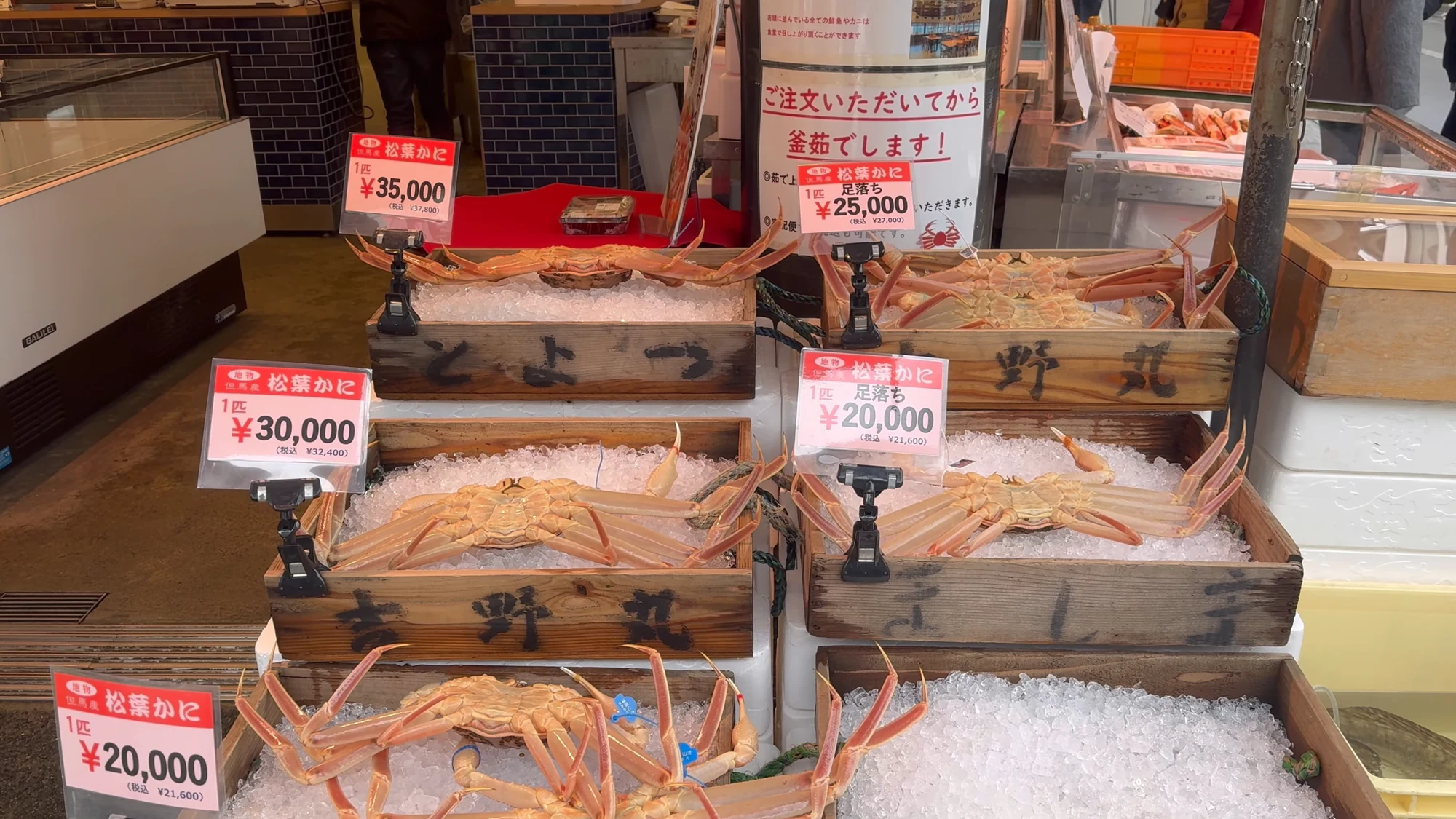
Winter is driven less by snow than by dinner: the crab is the event the whole regional calendar bends around.
The crab calendar, precisely
The season is not a vague "winter" — it runs on dates the whole coast knows by heart. Matsuba crab season opens November 6, when the San'in fleet takes its first sanctioned catch, and the opening weeks have a festival energy of their own: the tagged claws land at the nearby ports, the first crab kaiseki of the year go on the tables, and the town's booking curve bends upward overnight. If you want the crab at its freshest news value — the "it just opened" trip — aim for mid-to-late November, before the December premium fully arrives. January and February are the connoisseur's crab months: the cold is at its most theatrical, the crab at its fattest by local reckoning, and midweek rates meaningfully softer than the November-December weekends. The season closes in late March, and the town marks it the way it marks everything, publicly and at the station: in 2026 the association served free かに雑炊 (kani zōsui, crab rice porridge) and barrel sake in front of the station over the closing weekend of March 20–22 — a send-off event worth timing a late-season trip around (⚠️ held yearly in some form; confirm dates). The late-season play is the sleeper here. The same crab kaiseki that commands peak rates in December costs noticeably less in March, the snow-lottery odds are still alive early in the month, and the town is visibly exhaling. Our crab-season guide covers the grades, the tags and the menus in full, and the autumn guide covers the transition weeks when foliage on the ropeway gorge and the season's opening overlap — arguably the smartest ten days on the entire Kinosaki calendar.
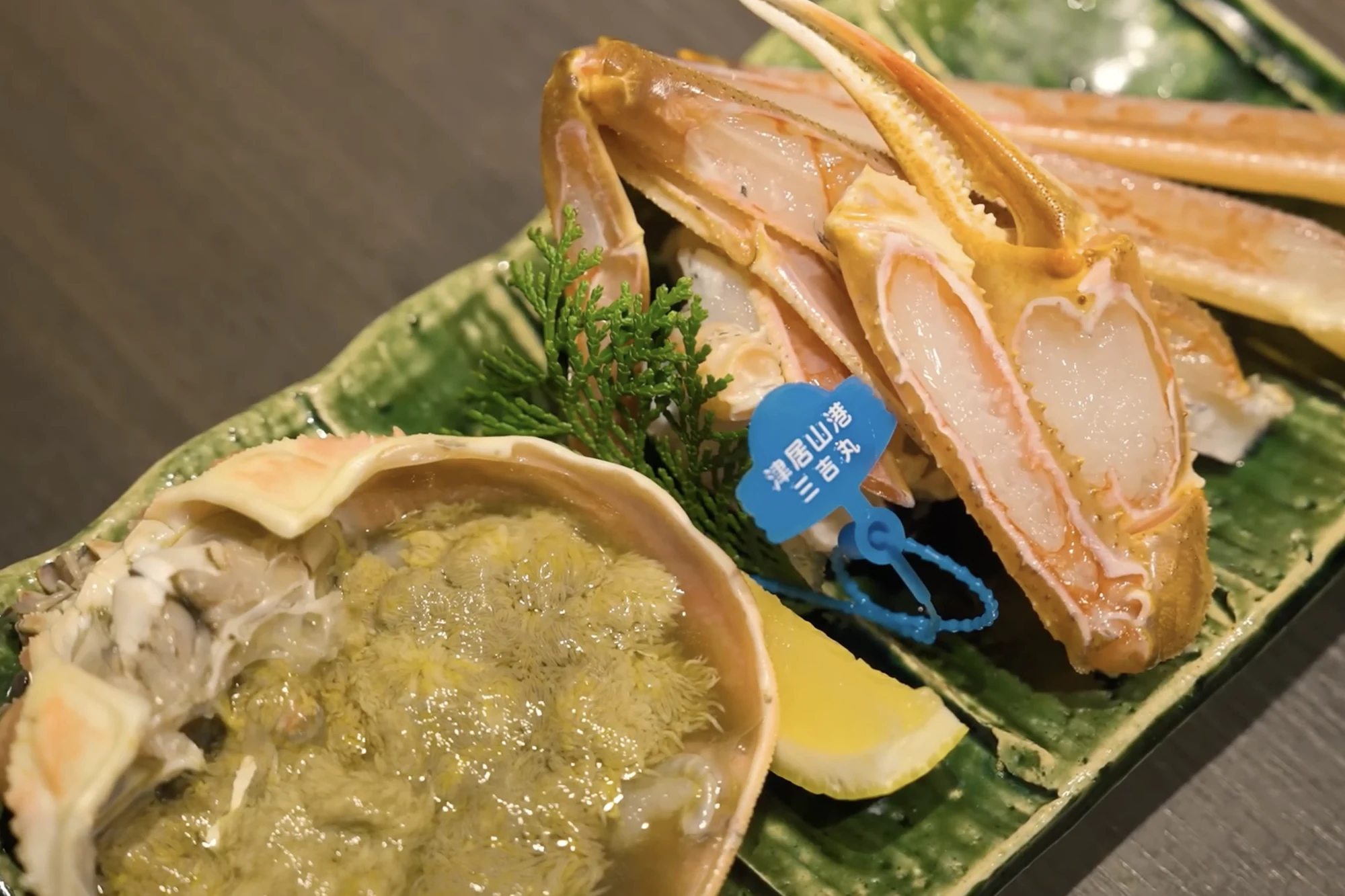
The season opens November 6 and closes in late March, with a send-off event at the station. ⚠️
Spring (April to May): blossom on the canal, town exhaling
Crab season closes in late March and the town exhales. Early April lines the Otani canal (大谿川, Ōtani-gawa) with cherry blossom, arguably Kinosaki's single most photogenic week, lanterns and petals over the water, and rates settle back to normal as the kitchens pivot to spring kaiseki. The weather turns ideal for the circuit: warm enough that the walks between baths are a pleasure, cool enough that the water still earns its welcome. Golden Week (late April into early May) imports Japan's domestic holiday crowds and prices for a week and a half; the weeks flanking it are calm, mild and underrated. ⚠️ confirm each year's blossom forecast and Golden Week dates at publish. Spring also carries the town's own festival: the 温泉まつり (Onsen Matsuri) on its fixed dates of April 23–24, when the founder's memorial fills the lanes with a water-blessing rite, a children's procession and street stalls — a local's festival rather than a tourist draw, and all the better for landing in a soft booking window. Through the blossom weeks the association also runs 夜桜月間 (yozakura gekkan, the night-cherry month), with the canal's trees lit after dark — petals, lanterns and steam in one frame, which is as close as spring gets to matching winter's poster. And once the petals drop, the willows take over: their fresh green over the water in May is the townscape at its most painterly, with nobody competing for the bridge. Book the blossom week a few weeks out; book the festival days like a normal soft-season weekend.
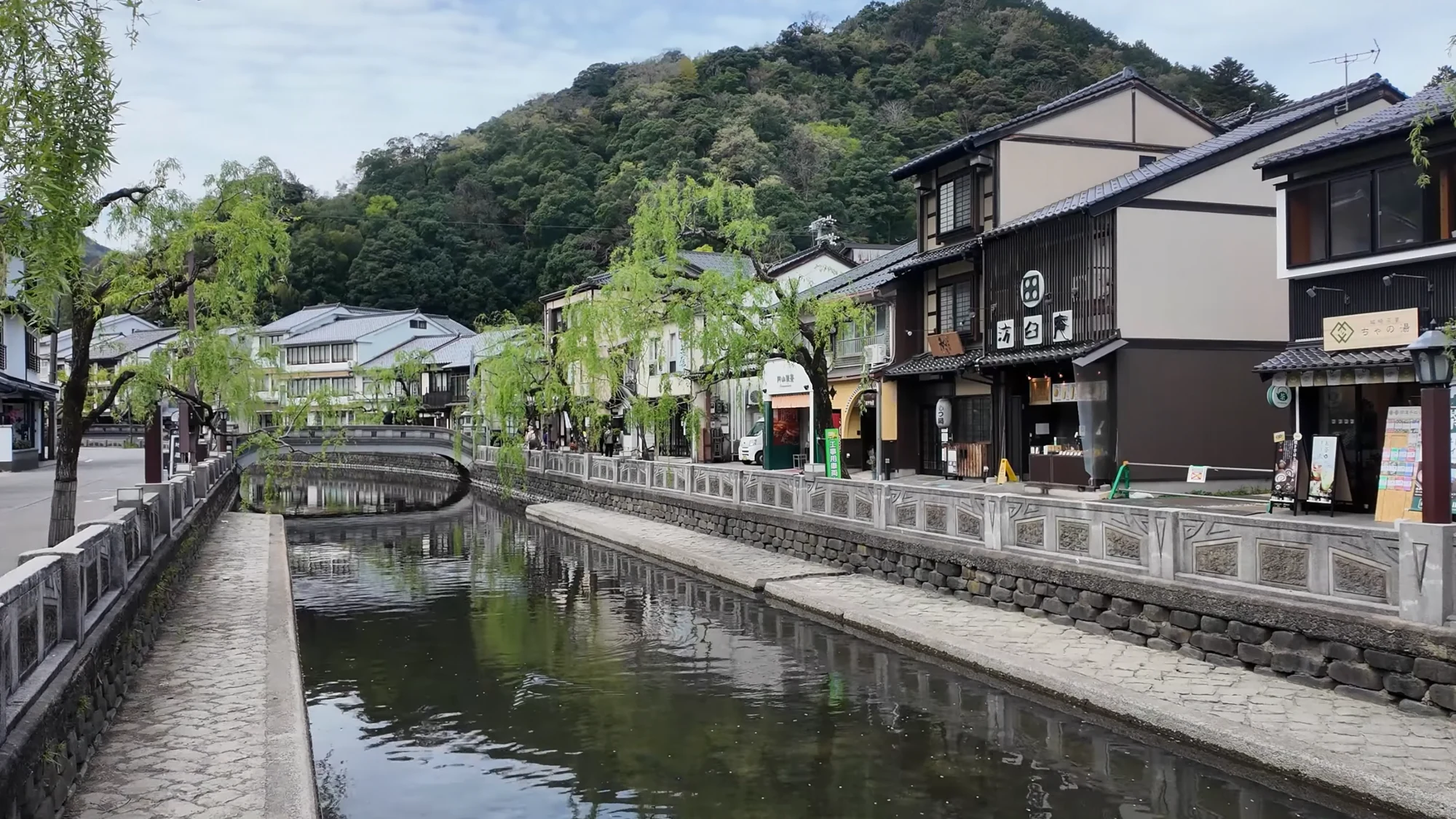
Blossom lines the canal for about a week in early April, then the willows carry May.
Summer (June to August): yukata weather, fireworks, the beach
Summer is when the yukata makes the most sense and the bathwater the least, and the town has long since solved that equation: lighter soaks, the river breeze through the willows, evening strolls that need no coat, and a calendar of small summer events, with fireworks over the river on summer evenings — the 温泉まつり (Onsen Matsuri), the festival honouring the town's founding, is a spring event, held every year on April 23–24; see the festival calendar below. ⚠️ verify each year's fireworks dates. Takeno Beach, one stop down the rail line, adds a genuine swimming beach to the itinerary, a pairing few onsen towns can offer. The rainy season (mid June to mid July) waters the green without ruining a town whose product is indoors and warm. Rates sit near the annual floor outside the Obon (お盆) holiday in mid August. For travelers who want Kinosaki itself, the streets, the ritual, the seven baths, with the smallest crowds and bills, summer is the honest sleeper. The summer event calendar is thicker than the town's quiet reputation suggests: alongside the scheduled fireworks, the association's own list runs from the しょうぶ湯まつり (Shōbu-yu Matsuri, the iris-bath festival, an early-summer bathing custom) to the ミスゆかたコンテスト (Miss Yukata contest) and, at the season's height, the 城崎温泉ふるさと祭り (Furusato Matsuri) — the town's biggest summer festival, which marked its 50th running in 2026. ⚠️ Individual event dates re-set yearly; check the association's calendar. None of it changes the fundamentals — the pass, the hours and the circuit run exactly as in February, minus the coat. Pack for humidity rather than heat: the bathwater does the cooling, oddly enough, and the evening river breeze does the rest.
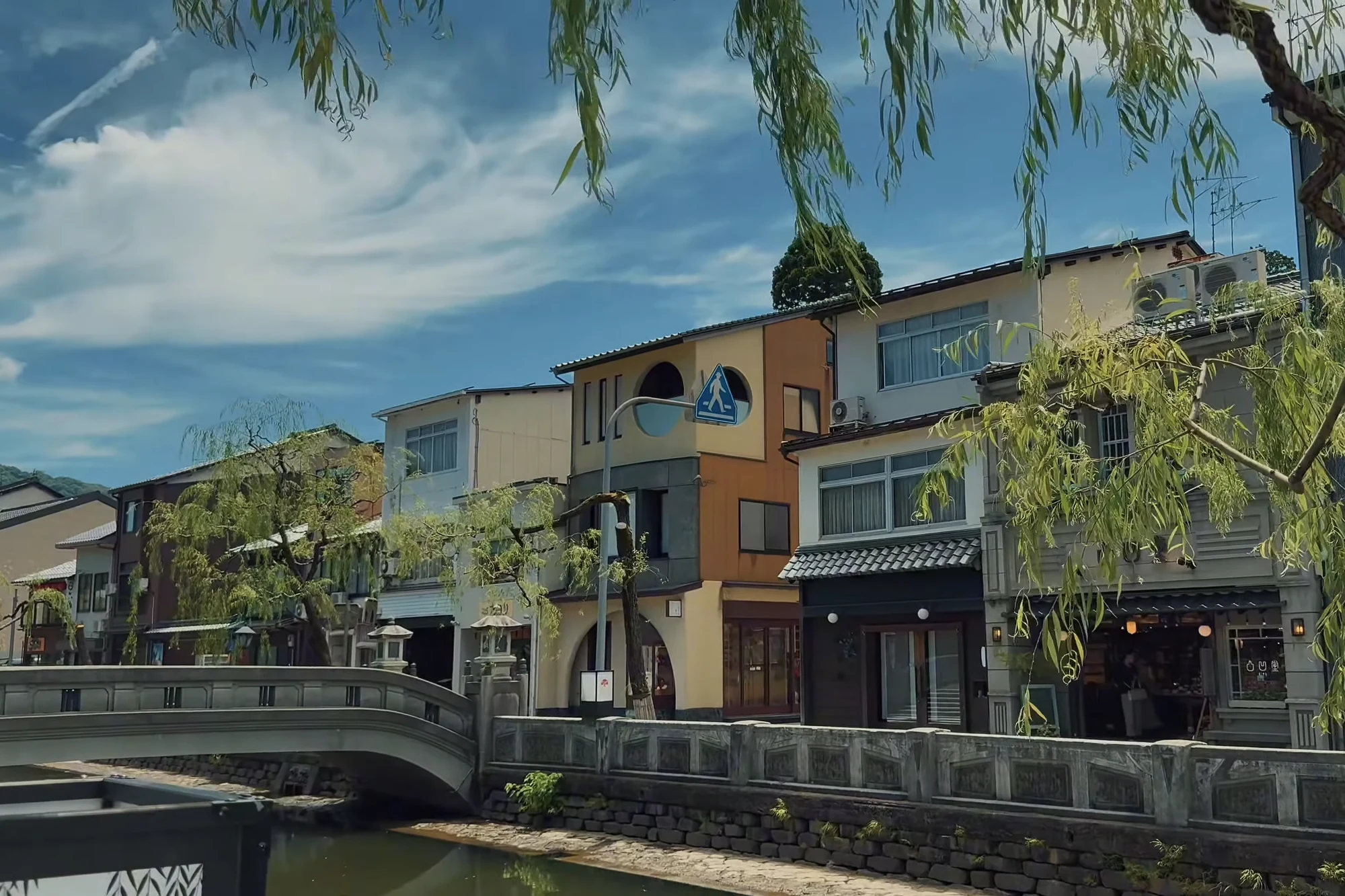
Summer sits near the annual price floor outside Obon, and the yukata finally makes sense in the heat.
The festival calendar, and what it changes
Kinosaki keeps a festival calendar that most English guides skip entirely, which is odd, because two of its dates are fixed and centuries-deep. The spring anchor is the 温泉まつり (Onsen Matsuri, the hot-spring festival), held every year on April 23–24 for the 開山忌 (kaisanki, the founder's memorial) of Dōchi Shōnin, the monk credited with the town's founding prayer. There is a water-blessing rite, a children's procession in period dress, and street stalls down the lanes — the one weekend the town formally celebrates the water itself. It lands two or three weeks after the blossom, so it does not collide with the cherry crowds. Autumn brings the bigger spectacle. The town's autumn festival — the association describes roughly 300 years of continuity — is held at 四所神社 (Shisho Shrine), the guardian shrine at the centre of the bath street, over two days in mid-October (October 14–15 in 2026: the 宵宮, the eve, then the 本宮, the main day). The highlight is the Seri at sunset on the second day, when festival floats clash at the Ō-hashi bridge in front of Ichi-no-yu — drums, bells and a normally serene bath town at full volume. Traffic restrictions close the streets; plan to be on foot, which in Kinosaki you were anyway. ⚠️ Dates shift by year — check the association's calendar. Summer runs on a different rhythm: the 夢花火 (Yume-Hanabi, "dream fireworks"), a five-minute burst over the canal at 21:00 on scheduled evenings from late July to late August (in 2026, July 30–August 21, excluding Wednesdays, weekends, holidays and mid-Obon), closing with the 灯篭流し (tōrō-nagashi, lantern floating) on the final night, when lit lanterns drift down the Otani canal. Five minutes sounds slight until you are standing on a stone bridge in a yukata when the sky opens. ⚠️ All summer dates re-set yearly.
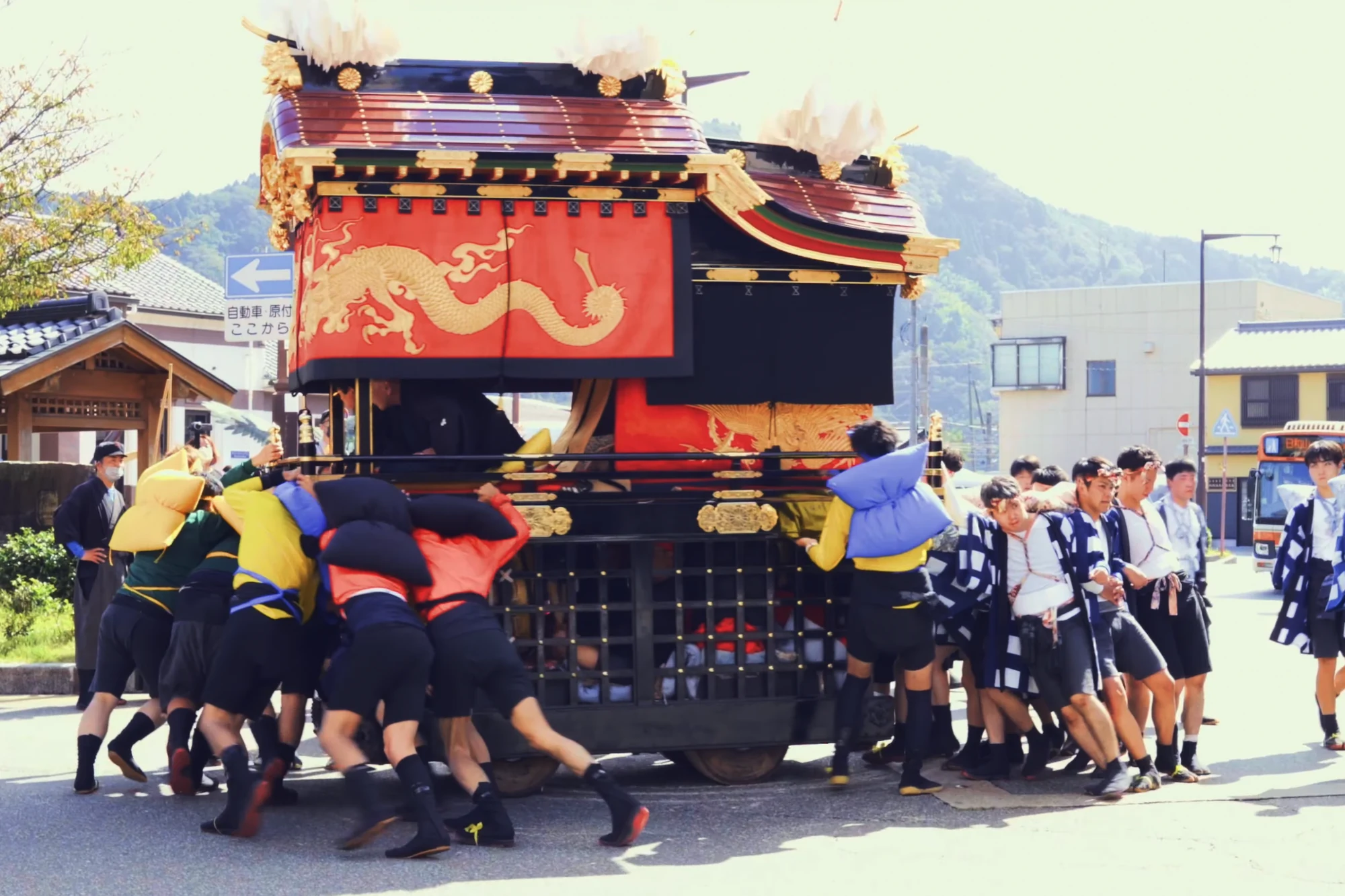
Two festival dates are fixed and centuries deep: April 23–24 for the water, mid-October at Shisho Shrine.
Autumn (September to October): the connoisseur's window
October may be the best month nobody books. The air sharpens into perfect bathing weather, the gorge around the ropeway begins to turn (peak color typically arrives early-to-mid November on the hill, just as crab season opens), the summer crowds are gone and the crab premium has not yet arrived. The same room that needs a four-month head start in January can often be had in October on a week's notice, with an autumn kaiseki, matsutake (松茸) pine mushrooms, sansai (山菜) mountain vegetables, the last of the summer fish, that suffers nothing in comparison. Photographers get the lantern streets without the queue for the bridge. If your trip is about the town rather than the crab, aim here and bank the difference. Autumn also holds two dates the value-hunters should plan around rather than avoid. The town's roughly 300-year-old autumn festival fills two mid-October days with drums and the float clash at the Ō-hashi bridge — covered in the festival section below — and the association dresses the season with 月見飾り (tsukimi kazari, moon-viewing displays) along the streets. And the season has a precise finale: November 6, when crab season opens onto the hill's peak foliage and October's gentle arithmetic ends overnight. The ten days either side of that date are the year's best-kept overlap — autumn colour, opening-day crab, and the last of the shoulder-season rates, all in one booking. Photographers should note the light runs the same way: the gorge colour peaks on the hill before the town's willows turn, so a single trip catches both only in that early-November overlap. ⚠️ Foliage timing shifts yearly.
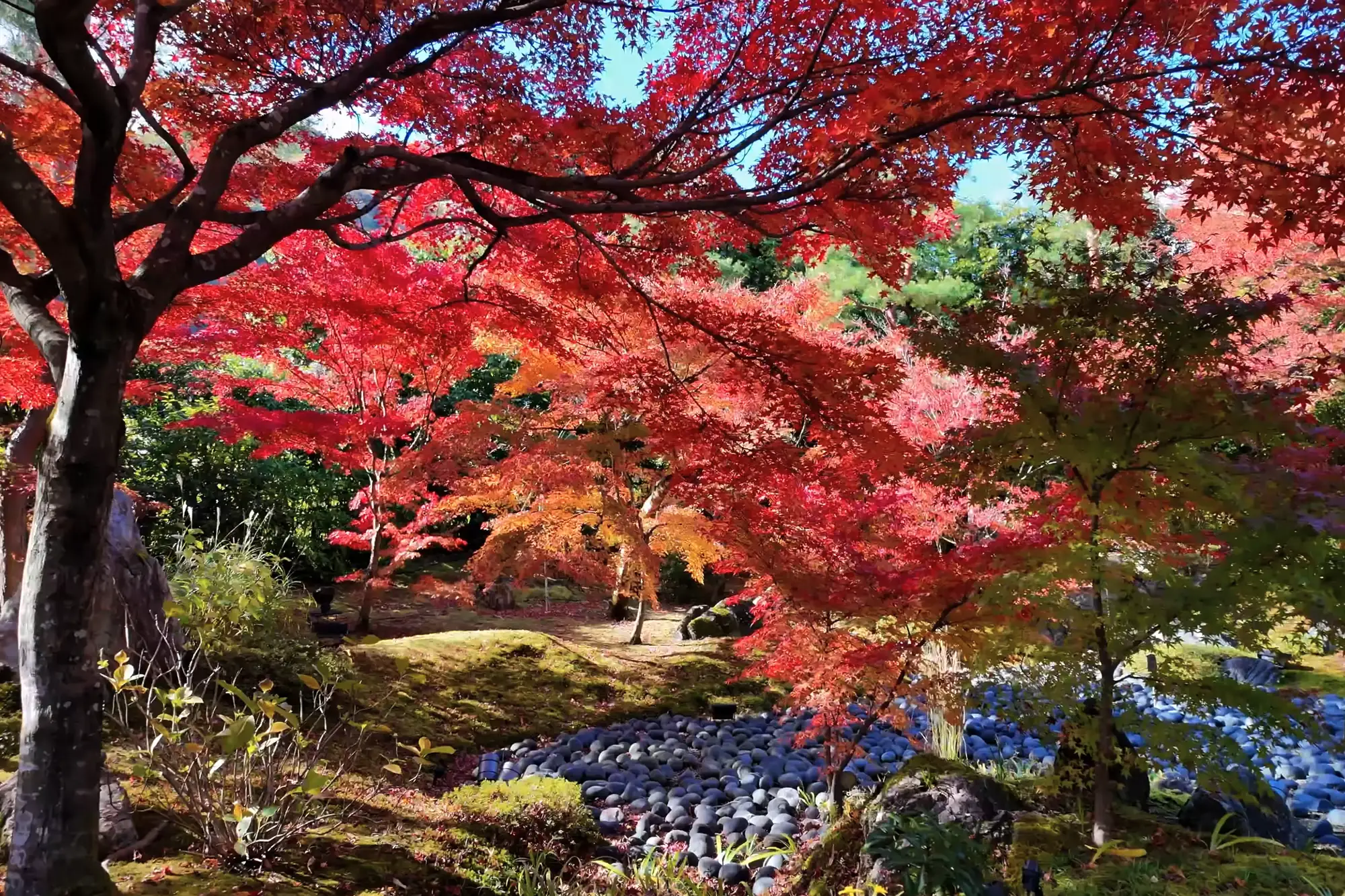
October may be the best month nobody books — the same room that needs four months in January takes a week.
The honest calendar
Book furthest ahead: crab-season weekends (Nov–Mar), New Year week, Golden Week, the blossom week of early April. Comfortable with normal planning: winter midweeks, May–June, September. Walk-in easy: October before the season turns, post-Golden-Week May, early summer midweeks. Two structural truths hold all year. The town's daily rhythm matters more than the month: day visitors thin out by late afternoon, and the lantern-lit evening circuit belongs to overnight guests in every season. And the baths close one day a week each on a rotating calendar, so plan circuits around the posted schedule rather than the guidebook, whatever month you come. Put lead times to those tiers and the plan writes itself: six months out for a December crab weekend at a famous house; two to three months for winter midweeks and the blossom window; a few weeks for May, June and September; and days for an October or early-summer midweek. If your dates are fixed and fall in a premium window, book the room first and build the rest of the trip around it — in Kinosaki the room is the scarce good, never the train. The rota deserves one more sentence of respect, because it is the one variable that punishes even well-booked trips: five houses closing across three different weekdays means a two-night midweek stay can still miss a specific house entirely. If one bath matters to you — Goshono-yu's waterfall, usually — check its closing day before you pick your nights, not after. The month sets the mood and the price; the weekday sets the menu.
The other calendar: which baths are open when you come
The month you choose matters less than most visitors think; the week's bath calendar matters more. Two houses are currently out of service entirely — Kou-no-yu closed for renovation, reopening expected November 2026, and Satono-yu closed since April 2024 — so the working circuit is five houses as of this writing, and any itinerary built around "all seven" needs adjusting until they return. ⚠️ Check the association's live bath-status page for reopenings. The five that are open run on a staggered weekly rota. As of this writing: Jizō-yu closes Mondays, Ichi-no-yu and Mandara-yu close Wednesdays, Goshono-yu and Yanagi-yu close Thursdays — so a Wednesday-to-Thursday overnight, for example, misses four different houses across its two days, while a Friday-to-Saturday misses none. Hours split by house as well: Ichi-no-yu, Goshono-yu and Jizō-yu open at 7:00 (7 am), while Mandara-yu and Yanagi-yu open at 15:00 (3 pm), all running to 23:00 (11 pm) with last entry thirty minutes before close. ⚠️ Hours and rota shift; verify for your dates. Two planning consequences follow, in any season. First, the morning bath — winter's best hour, with steam thick over the water and the streets empty — belongs to the three 7:00 houses, so aim your dawn ambitions there. Second, the association publishes a live congestion page showing each house's current crowding, which turns the evening circuit from guesswork into a route: check it from your room, walk to the quiet one. A town that publishes real-time bath traffic is a town that expects you to plan around baths rather than months, and it is right.
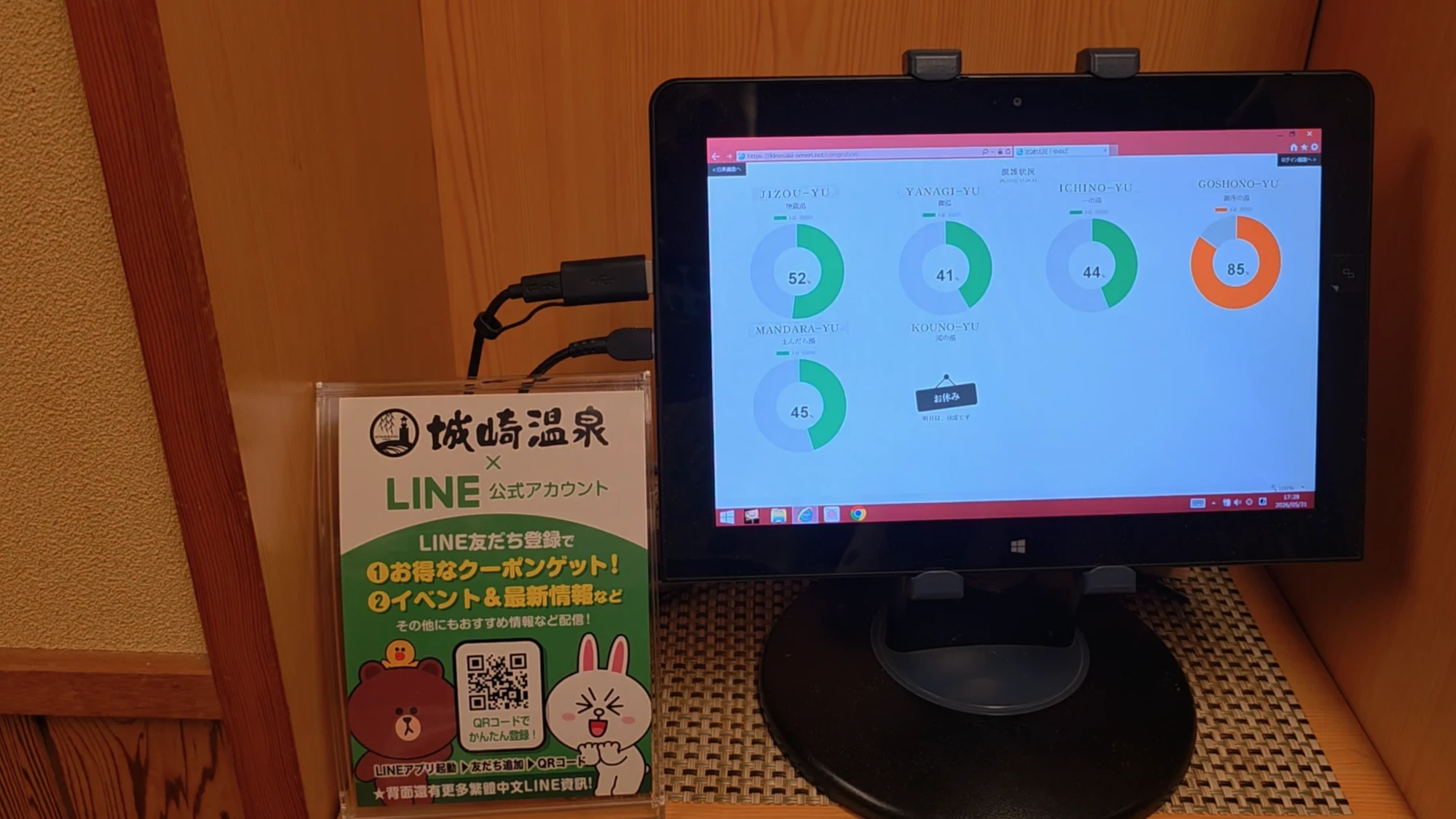
The association publishes live congestion, which turns the evening circuit from guesswork into a route.
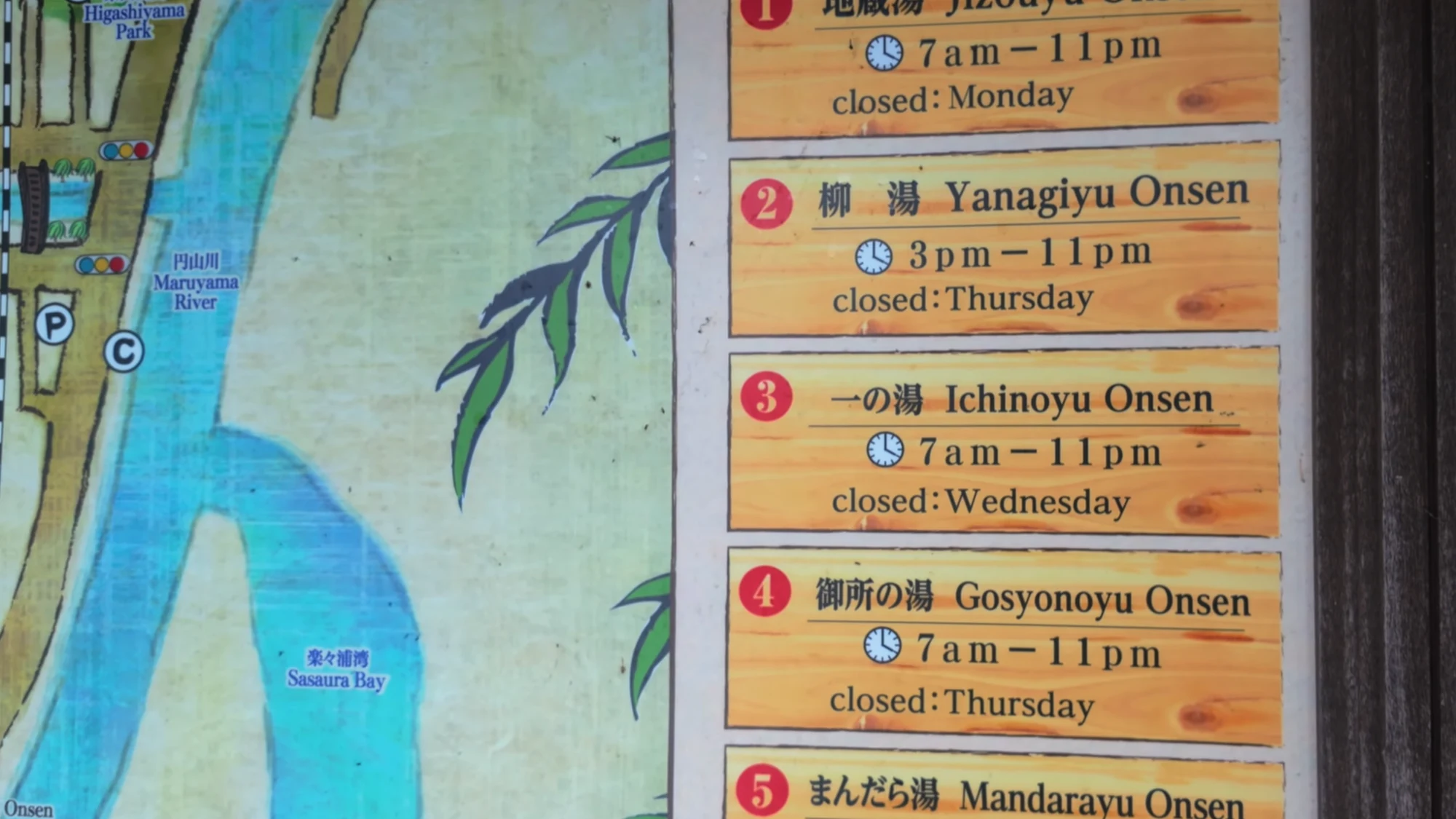
The week matters more than the month: a Wednesday-to-Thursday stay misses four different houses.
The verdict
Come between November and March if the crab dinner is the trip, booked early, midweek if you can. Come the first week of April for the canal in blossom, or October for the town at its best price-to-pleasure ratio. Come in summer if you want yukata weather and the streets to yourselves. Kinosaki built itself to work year-round a century before tourism marketing discovered the idea; the only real mistake is a day trip in any month, which forfeits the evening the whole town is designed around. If you are still torn, decide by what you will remember. The crab dinner is the memory that costs the most and needs the most planning; the snow over the lanterns is the memory you cannot book, only improve the odds of; the blossom and the festivals are the memories with dates attached; and the empty October morning bath is the memory that costs nothing and is available on a week's notice. Match the trip to the memory you actually want, and the calendar sorts itself. There is no wrong month on this list — only wrong expectations carried into the right one. And whichever you choose, arrive on the earliest train your schedule allows: every season's version of Kinosaki is at its best in the hours the day visitors have not yet reached, and that advantage is free in all twelve months. That is the honest luxury of a town built for year-round bathing: the question is never whether to come, only which Kinosaki you want to meet.
Which week, exactly? The honest shortlist
If the question is not "which season" but "book me the week," here is the shortlist we would defend. For the full winter postcard at survivable prices: the third or fourth week of January, midweek — deep cold, fat crab, and rates a tier below the December weekends. For the crab-opening energy: the second week of November, when the season is days old and the foliage on the ropeway gorge is at or near peak — two headline reasons in one trip. For the photograph everyone wants: the first week of April, blossom over the canal, booked a few weeks out. For value with nothing sacrificed: the second and third weeks of October — perfect bathing weather, rooms on short notice, and in a mid-October year like 2026 the autumn festival lands in the middle of it (October 14–15), which turns the value week into a spectacle week at no extra cost. For the town at its most local: late June, rainy-season midweek, when the willows are at their greenest, the baths are warm against the damp, and you will hear more Kansai dialect than English on the bath street. The weeks to avoid unless they are the point: New Year (December 29–January 3, the year's peak prices and crowds), Golden Week (late April–early May), and Obon (mid-August) — Japan's three domestic travel surges, all of which fill Kinosaki with its own countrymen. That is not a defect, and seeing the town full of Japanese travellers in yukata is its own argument — but book far ahead and expect the premium.
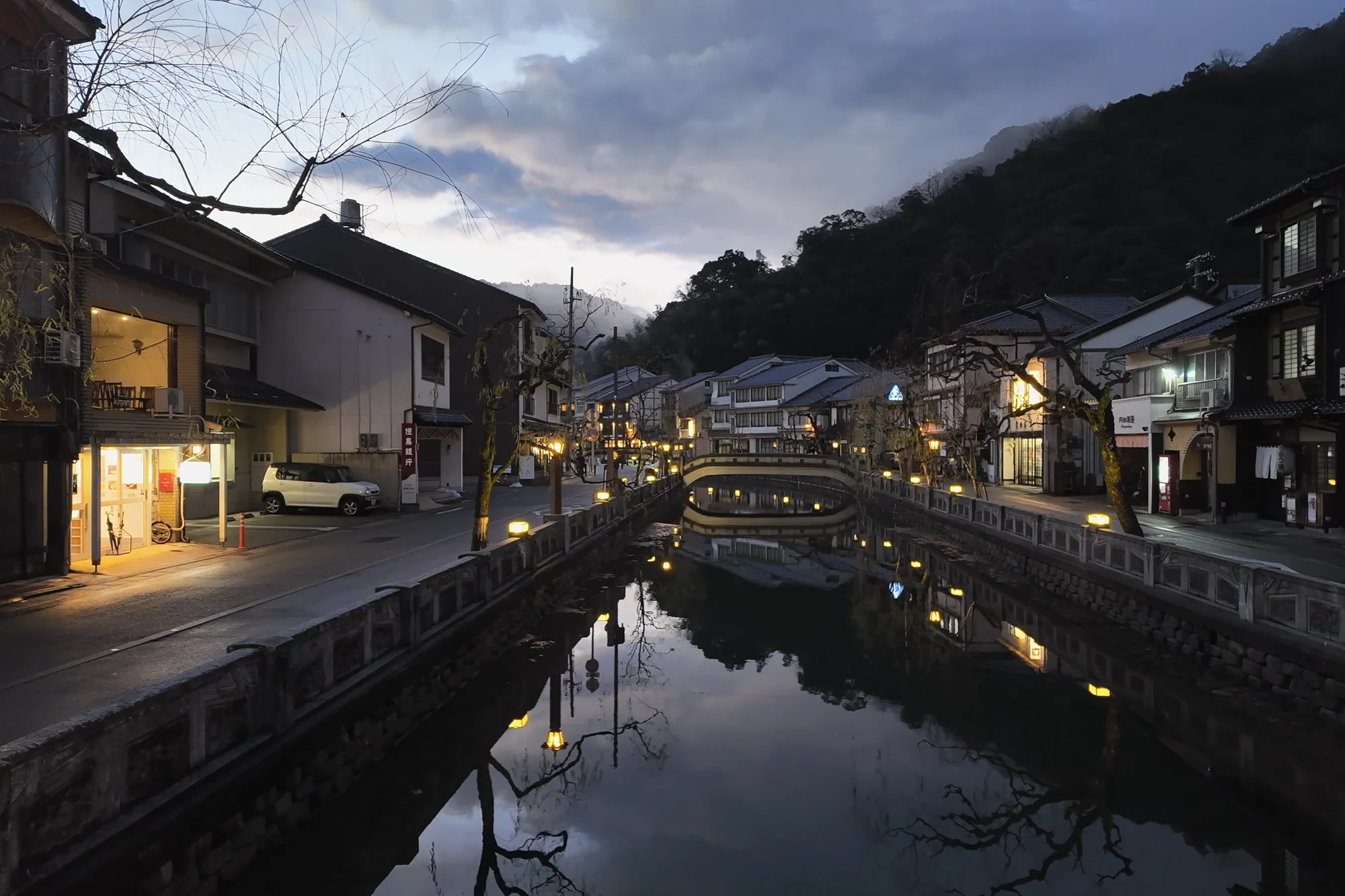
Whichever month you pick, arrive on the earliest train — the best hours are the ones day visitors miss.
Tips
Book crab-season weekends 3–6 months ahead at the famous houses; midweek late January–February gets full winter at a meaningful discount.
October is the connoisseur's window: perfect bathing weather, no crab premium, rooms on a week's notice.
Early April's blossom week along the canal needs only a few weeks' lead — the photogenic bargain.
Avoid New Year week (Dec 29–Jan 3) and Golden Week unless the premium is deliberate.
Whatever the month, the evening circuit belongs to overnight guests — the daily tide matters more than the season.
A mid-October trip can catch the autumn festival (October 14–15 in 2026) inside the year's best-value window — the Seri float clash at sunset on day two is the town at full volume.
Five of the seven baths are operating as of this writing (Kou-no-yu closed for renovation, reopening ~November 2026; Satono-yu closed since April 2024) — check the live status page before promising anyone a specific house.
Verified by The Japan Onsen Society
Show all sources
Verified July 7–16, 2026; event calendar, bathhouse hours and closures verified September 22, 2026. Primary Japanese sources:
温泉まつり — 城崎温泉観光協会 (Kinosaki Onsen Tourism Association, event page): [https://kinosaki-spa.gr.jp/event/onsen-matsuri/](https://kinosaki-spa.gr.jp/event/onsen-matsuri/)
外湯 — 城崎温泉観光協会 (Kinosaki Onsen Tourism Association — hours, closing days, prices): [https://kinosaki-spa.gr.jp/about/spa/](https://kinosaki-spa.gr.jp/about/spa/)
イベント情報 — 城崎温泉観光協会 (Kinosaki Onsen Tourism Association — Yume-Hanabi, lantern floating, autumn festival, crab-season events): [https://kinosaki-spa.gr.jp/event/](https://kinosaki-spa.gr.jp/event/)
外湯めぐり発祥の地!温泉天国★城崎温泉 — 豊岡市観光公式サイト (Toyooka City Official Tourism Site): [https://toyooka-tourism.com/recommend/onsen/kinosaki_sotoyu/](https://toyooka-tourism.com/recommend/onsen/kinosaki_sotoyu/)
Related guides
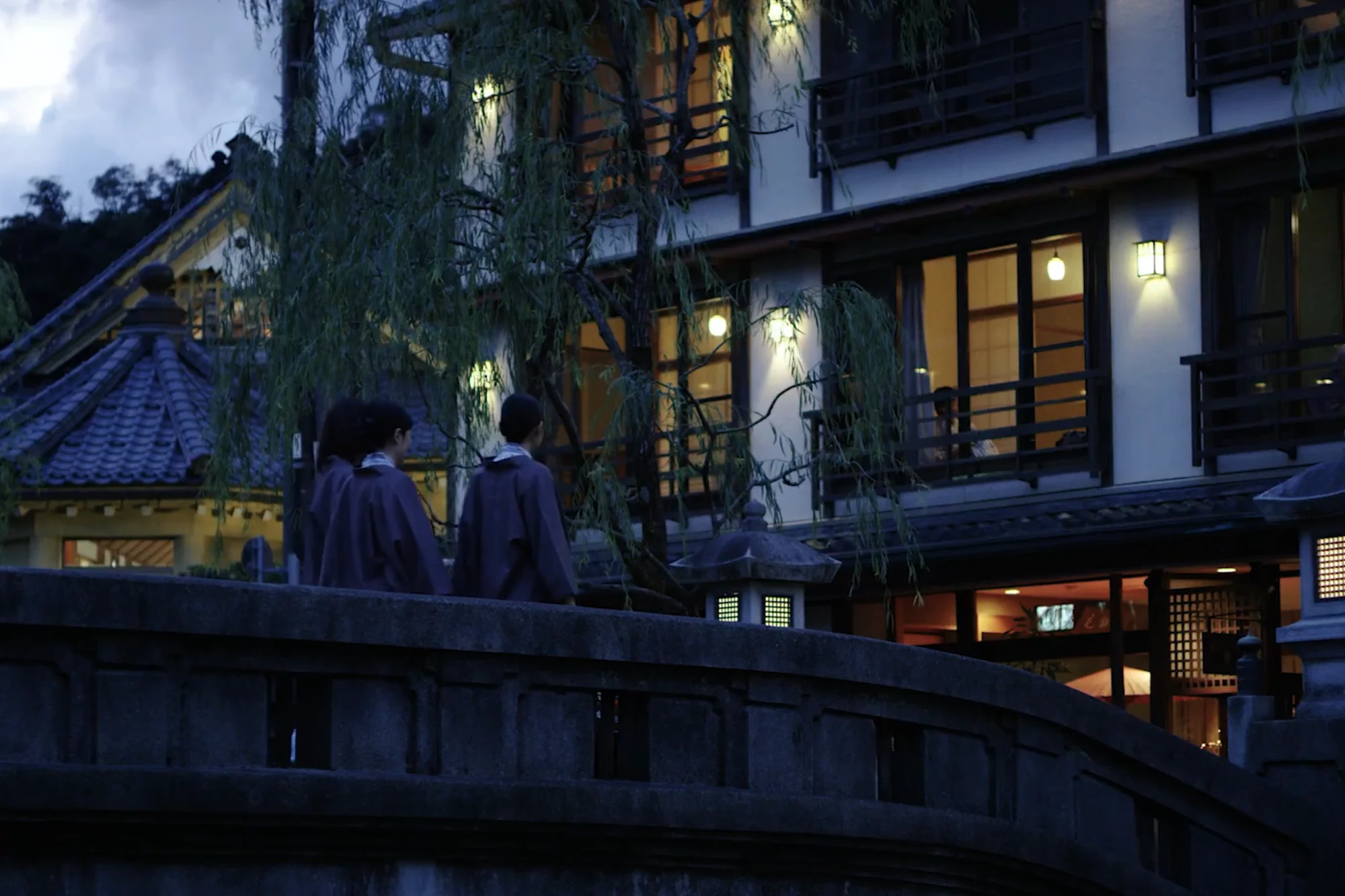
When to Visit
Kinosaki complete guide
Seven public bathhouses, one shared spring, and a law that keeps them the centre of town. Start here.
When to Visit
Crab season
Matsuba crab season opens on November 6 and runs to March. It is why winter rooms disappear early.
When to Visit
The 7 bathhouses
Same water in all seven houses. What changes is the room, the story, and the blessing on the door.
When to Visit
How long to stay
One night works, and most people do exactly that. Two nights is when the town stops being a stop.
When to Visit
Wearing yukata
Yukata are worn in the street here, not only inside your room. Here is how to tie one and walk in it.