Overview
Most onsen towns ask you to choose one inn and stay inside it. Kinosaki was built to work the other way around. The town itself behaves like a single large ryokan — by law, not just by slogan: a municipal ordinance caps the size of inn in-house baths to protect the shared sotoyu (our sotoyu-system page tells that story). The streets are the corridors, the willow-lined Otani canal is the garden, and the seven public bathhouses are the baths you share with everyone else in town. You check in, change into the yukata your inn provides, and spend the evening clattering between bathhouses in geta. That arrangement, refined over centuries, is why roughly 85 percent of visitors stay the night rather than passing through, and it is the single fact that should shape how you plan a trip. This guide covers what makes Kinosaki worth the journey, how the seven baths and the pass actually work, when to come, how to get there without a car, and where to sleep. Where prices and timetables move, we flag them so you can confirm before you travel.
The town that works like one ryokan
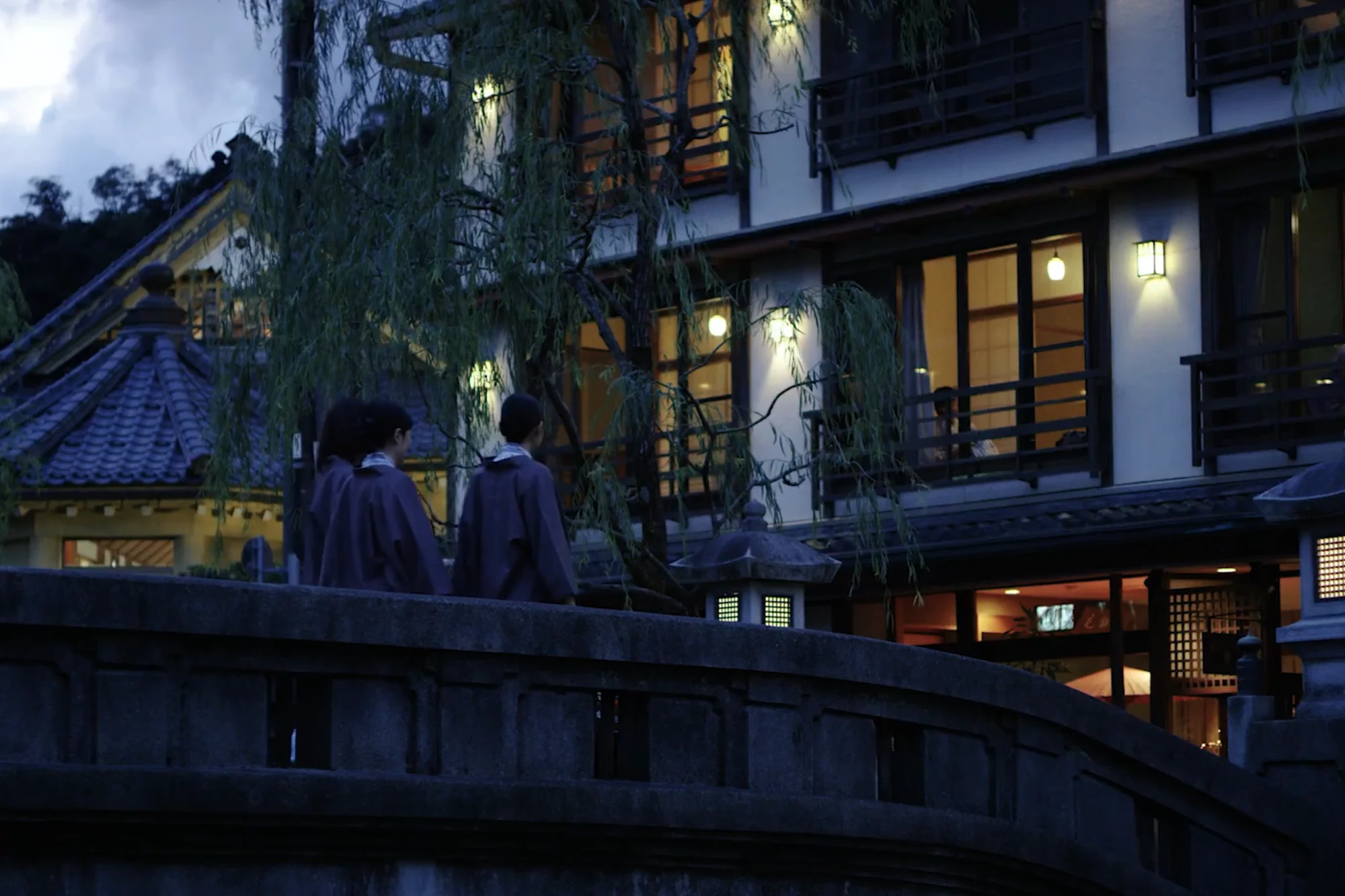
Kinosaki sits in northern Hyogo, close enough to the Sea of Japan that winter delivers snow and crab in the same week. The town is small and almost entirely walkable, strung along a canal crossed by low stone bridges and lit by lanterns after dark. Two founding legends still shape the place. One credits the monk Dochi Shonin (道智上人, Dōchi Shōnin), who is said to have completed a thousand days of prayer in the early 8th century, after which a spring rose at the site of today's Mandara-yu. The other tells of an injured stork, a kounotori (コウノトリ), that healed its leg in the shallows. That stork lends its name to the Kounotori (こうのとり, "stork") limited express that now carries visitors in from Osaka. Onsenji (温泉寺), the temple on the wooded slope of Mt. Daishi above town, has overseen the waters ever since, and you can still ride the ropeway up to visit it. What you feel on the ground is calm and ritual rather than spectacle. The appeal is not one dramatic bath or a famous view. It is the cumulative pleasure of a small town arranged entirely around bathing, walking, and eating well, with nothing asking for your attention except the next bathhouse.
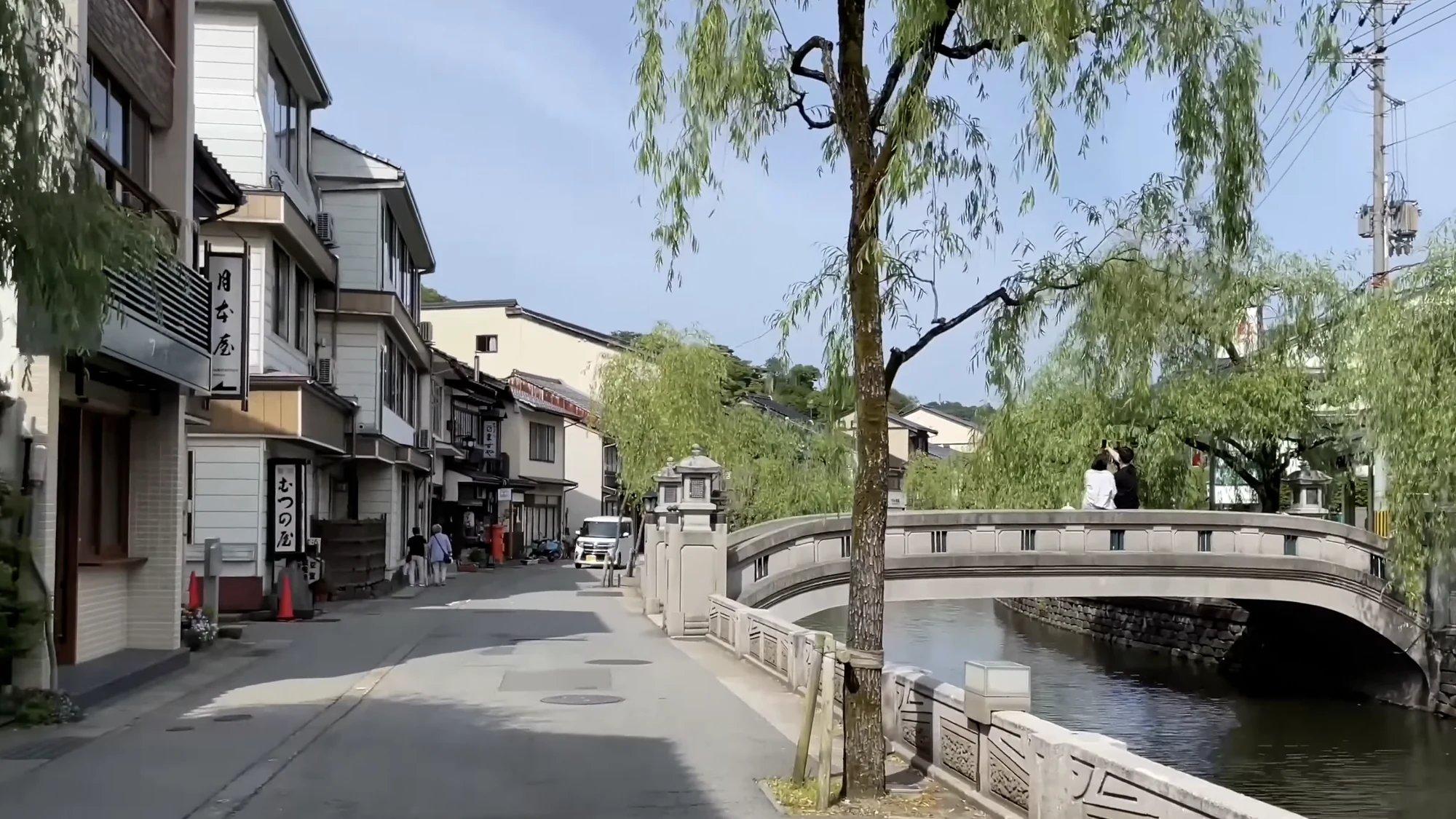
A bridge roughly every hundred metres, and the whole town walkable end to end in fifteen minutes.
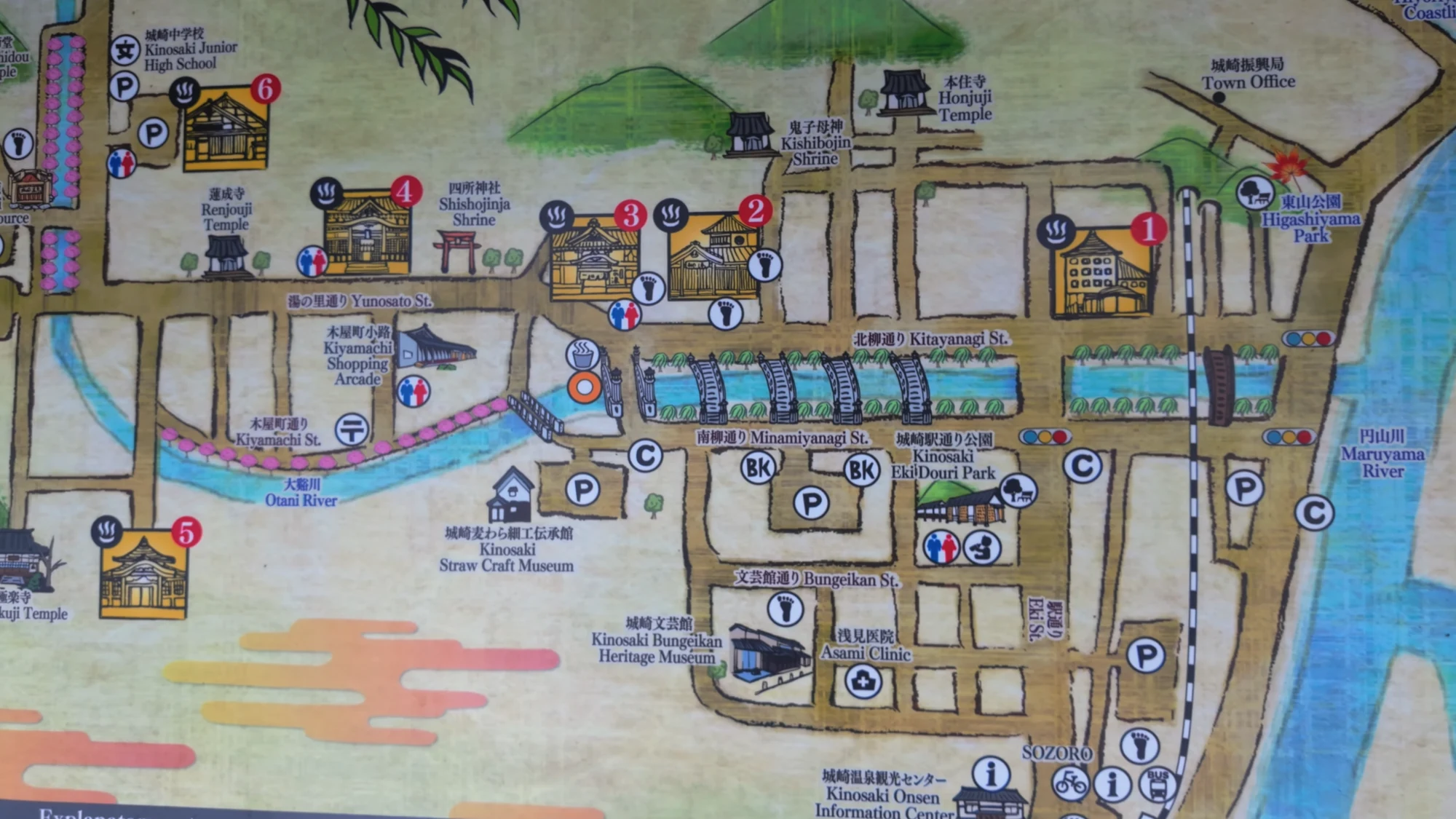
One street, one canal, seven bathhouses, and the Sea of Japan eight kilometres (5 mi) north.
Why the whole town works as one inn: the ordinance
Kinosaki's defining arrangement is not a slogan. It is municipal law. A town ordinance caps the size of the bath an inn may build inside its own walls — the 内湯 (uchiyu, a private bath inside an inn) — so that no ryokan can grow a bath grand enough to keep its guests in for the night. The consequence is the seven 外湯 (sotoyu, the public bathhouses): with in-house baths held deliberately small, the evening's real bathing happens in public, on the street, in the company of the whole town. The city's own tourism office states the purpose plainly: the cap protects the shared bathhouse system and the spring resource itself, which is drawn and distributed collectively rather than tapped inn by inn. That is the meaning of the phrase the town uses to describe itself, まち全体がひとつの旅館 (machi zentai ga hitotsu no ryokan, "the whole town is one ryokan"): the station is the front entrance, the streets are the corridors, the inns are the guest rooms, and the seven bathhouses are the shared grand bath. It reads like marketing until you notice it is a description of the legal structure. Kinosaki also calls itself the 外湯めぐり発祥の地 (sotoyu-meguri hasshō no chi, "the birthplace of bath-hopping"), and on the evidence the claim holds: nowhere else in Japan is the circuit between public baths engineered this deliberately into how a town is governed. The consequences reach every hour of your stay. It is why your inn hands you a yukata and expects you to leave the building. It is why the free pass exists at all: an inn that cannot offer you a grand bath compensates by buying you seven. And it is why the street at nine in the evening is full of bathers instead of empty — in most onsen towns the evening happens indoors, behind each ryokan's own doors, while Kinosaki legislated its evening out onto the street and then built a street worth the walk. The full story of the rule, and where it came from, is in our sotoyu-system guide.
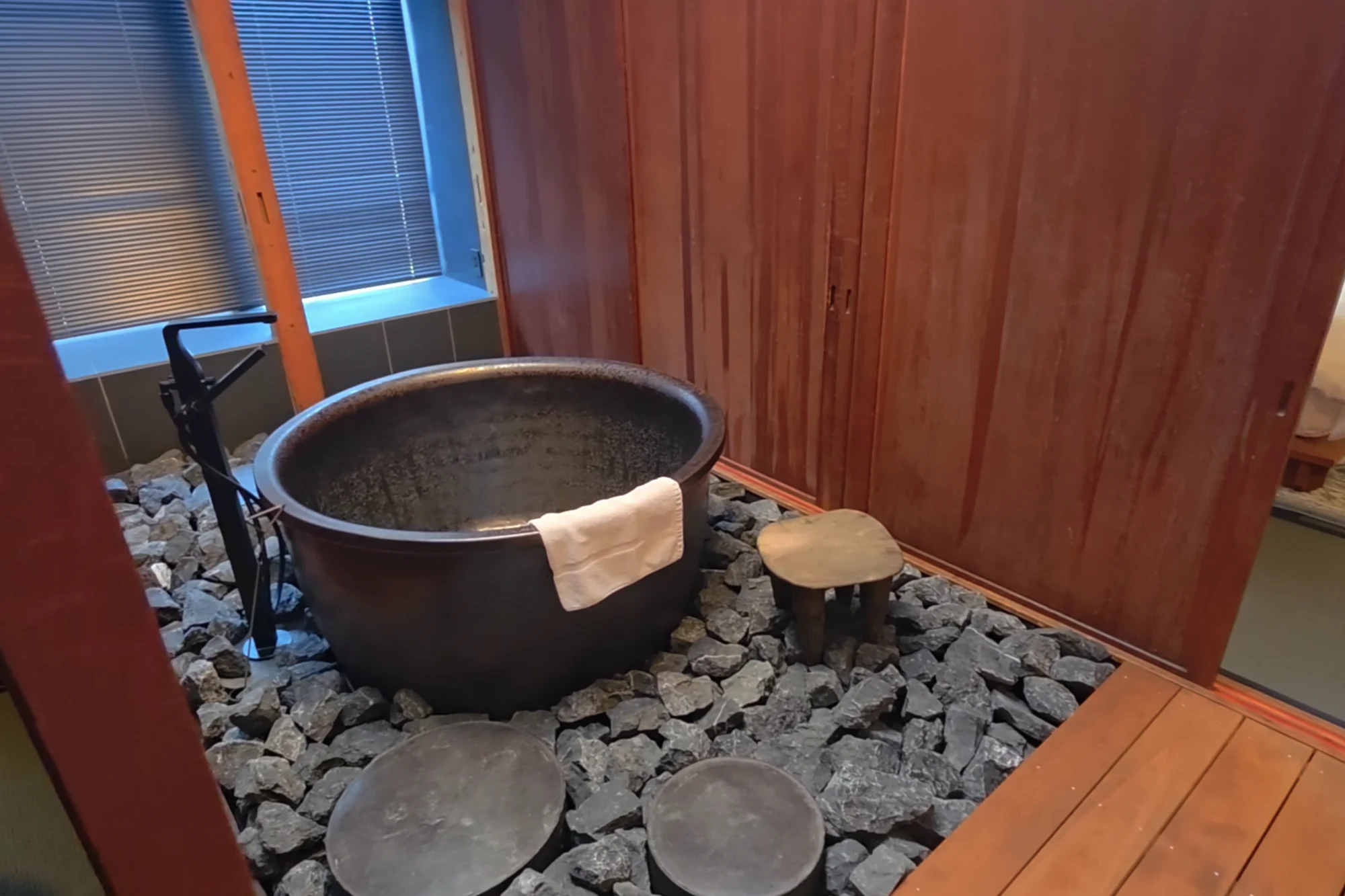
An ordinance caps the size of an inn's own bath. That one rule produced everything else on this page.
The seven bathhouses, and how the pass actually works
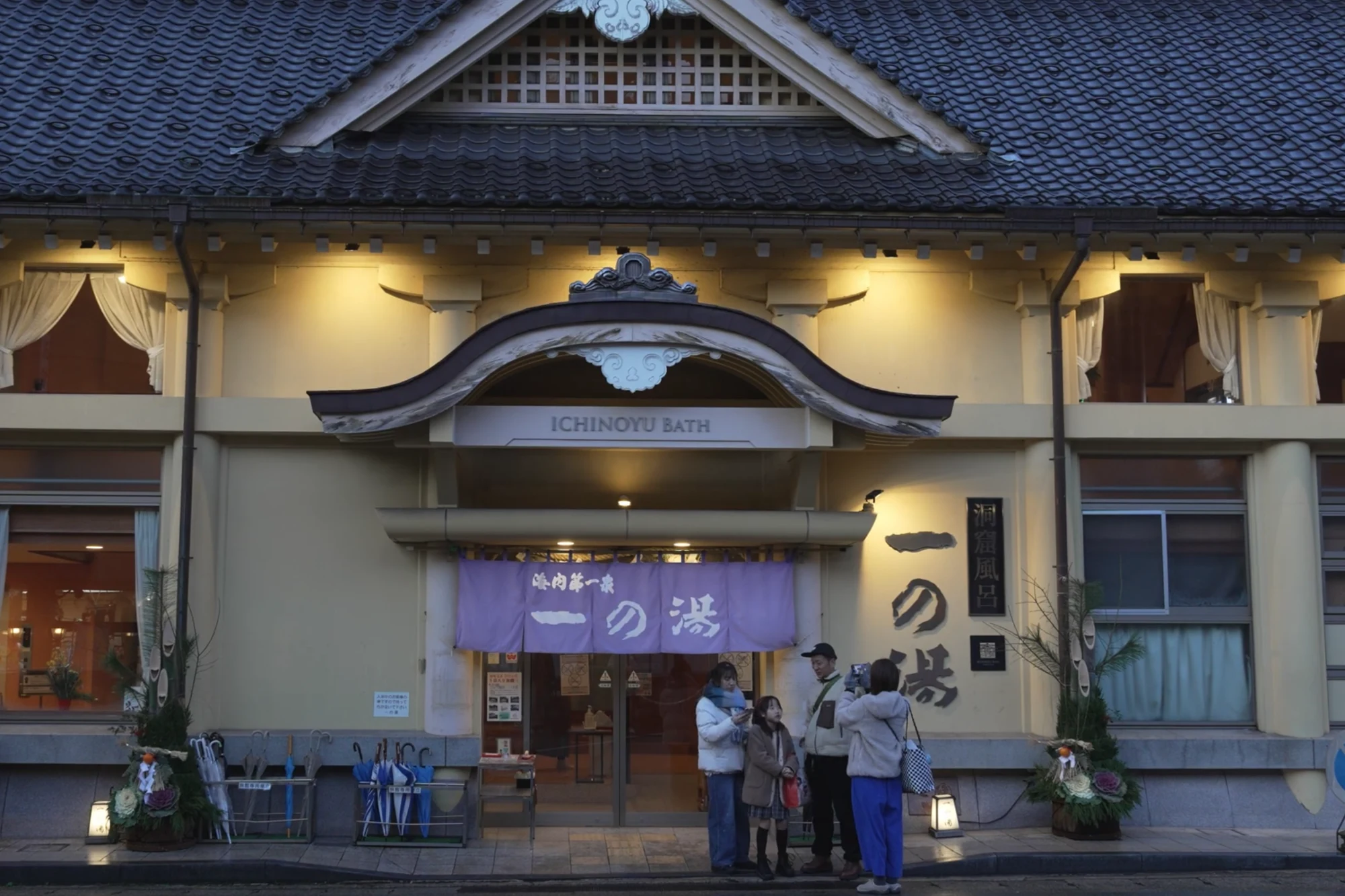
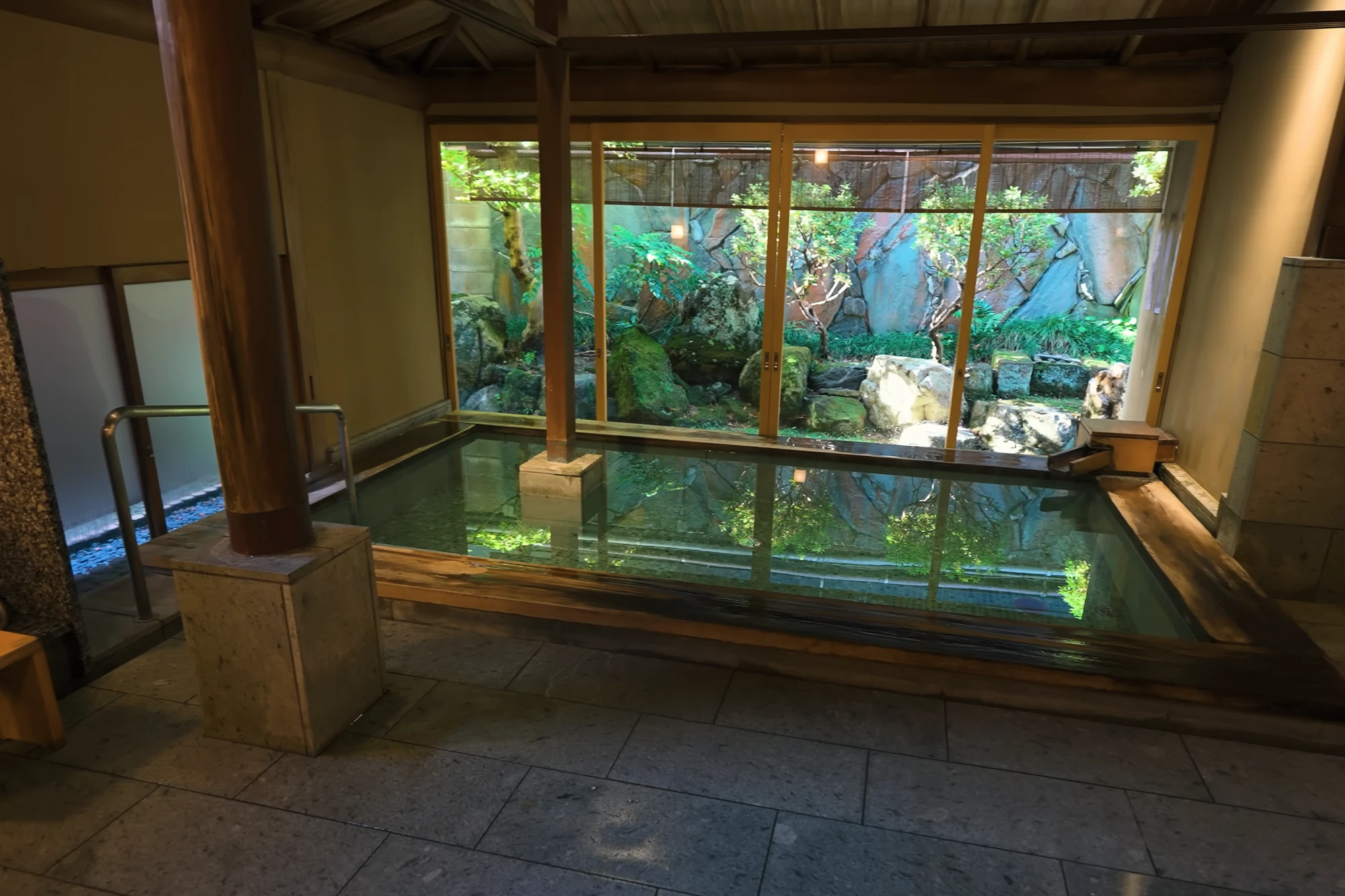
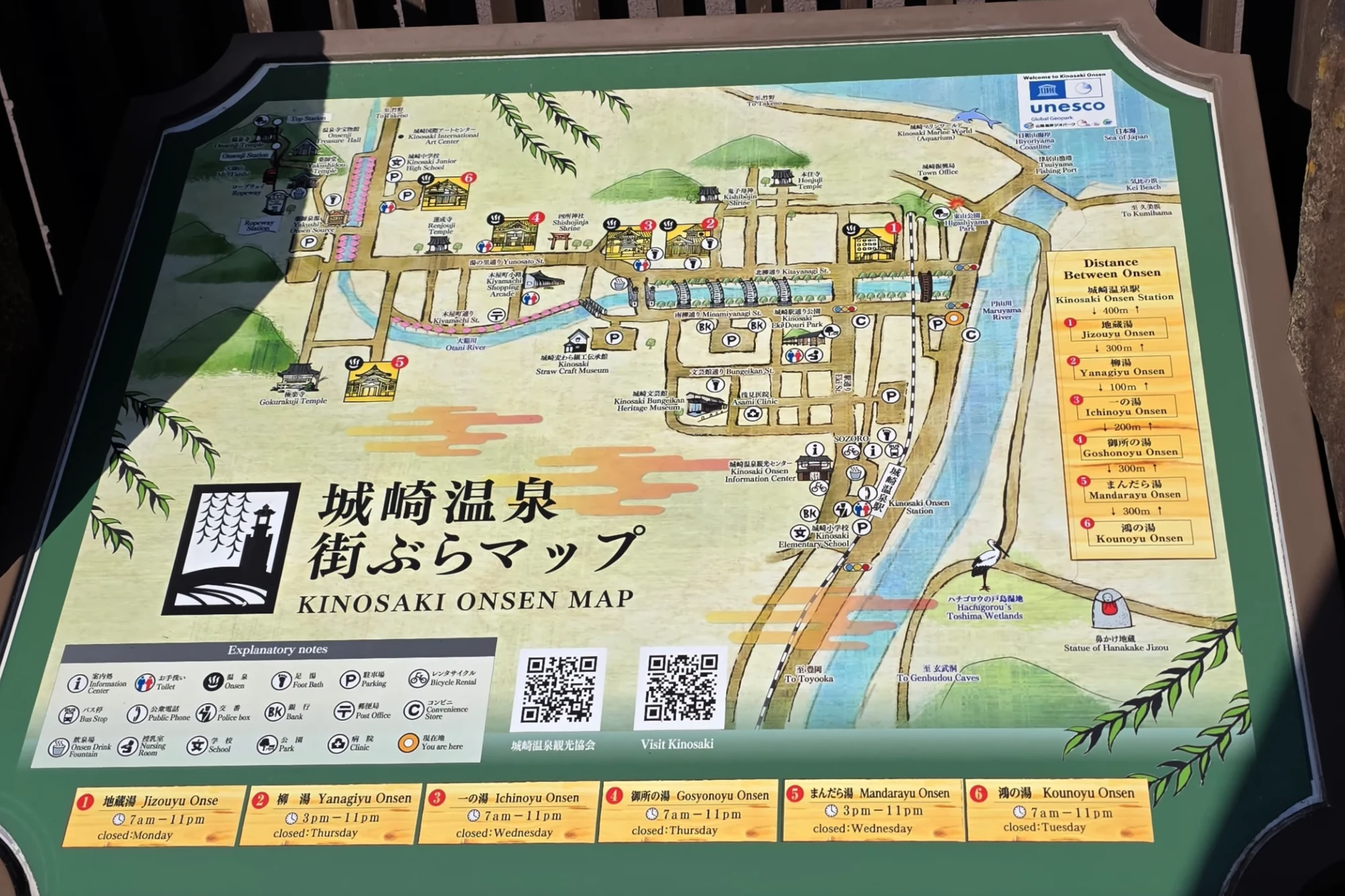
The seven sotoyu line a single walkable kilometre (0.6 mi), and each has its own architecture and lucky association. Satono-yu (⚠️ closed since April 2024), beside the station, is the largest, with two themed upper floors that alternate between men and women and river views from the baths. Jizo-yu is the locals' bathhouse, shaped like a lantern, plain and usually quiet. Yanagi-yu is the smallest and reputedly the hottest, tied to fertility and safe childbirth. Ichino-yu is the showpiece, its facade modeled on a kabuki theatre, with a cave bath carved into the rock behind it. Goshono-yu, the so-called beauty bath, has palace-style architecture and an open-air bath facing a hillside waterfall, and it is the favourite of many first-time visitors. Mandara-yu marks the spiritual origin point of the springs. Kou-no-yu (🚨 closed for renovation, reopening expected November 2026), the oldest, sits at the quiet western end near the ropeway and keeps a garden rotenburo and the stork legend to its name. The pass is the part most visitors get wrong before they arrive, so it is worth being precise. Each bathhouse charges ¥800 (about US$5.30) at the door if you pay individually. Almost nobody does. Anyone staying at a Kinosaki ryokan receives the yumepa (ゆめぱ) pass free at check-in, often as a wristband or card, and it covers the sotoyu from check-in until 13:00 on checkout day at most inns, per the city DMO. Day visitors who are not staying in town buy a one-day pass for ¥1,500 (about US$10) — ¥750 (about US$5) for children — which also covers all seven. Each bath closes one day a week, on different days, and the town posts a weekly calendar, so the smart move is to plan your circuit around what is open rather than around a fixed wishlist. Opening hours run roughly from 7:00 to 23:00, though a few houses do not open until the afternoon. Towels can be rented or bought on site, baths are gender-separated, and all seven accept tattooed bathers.
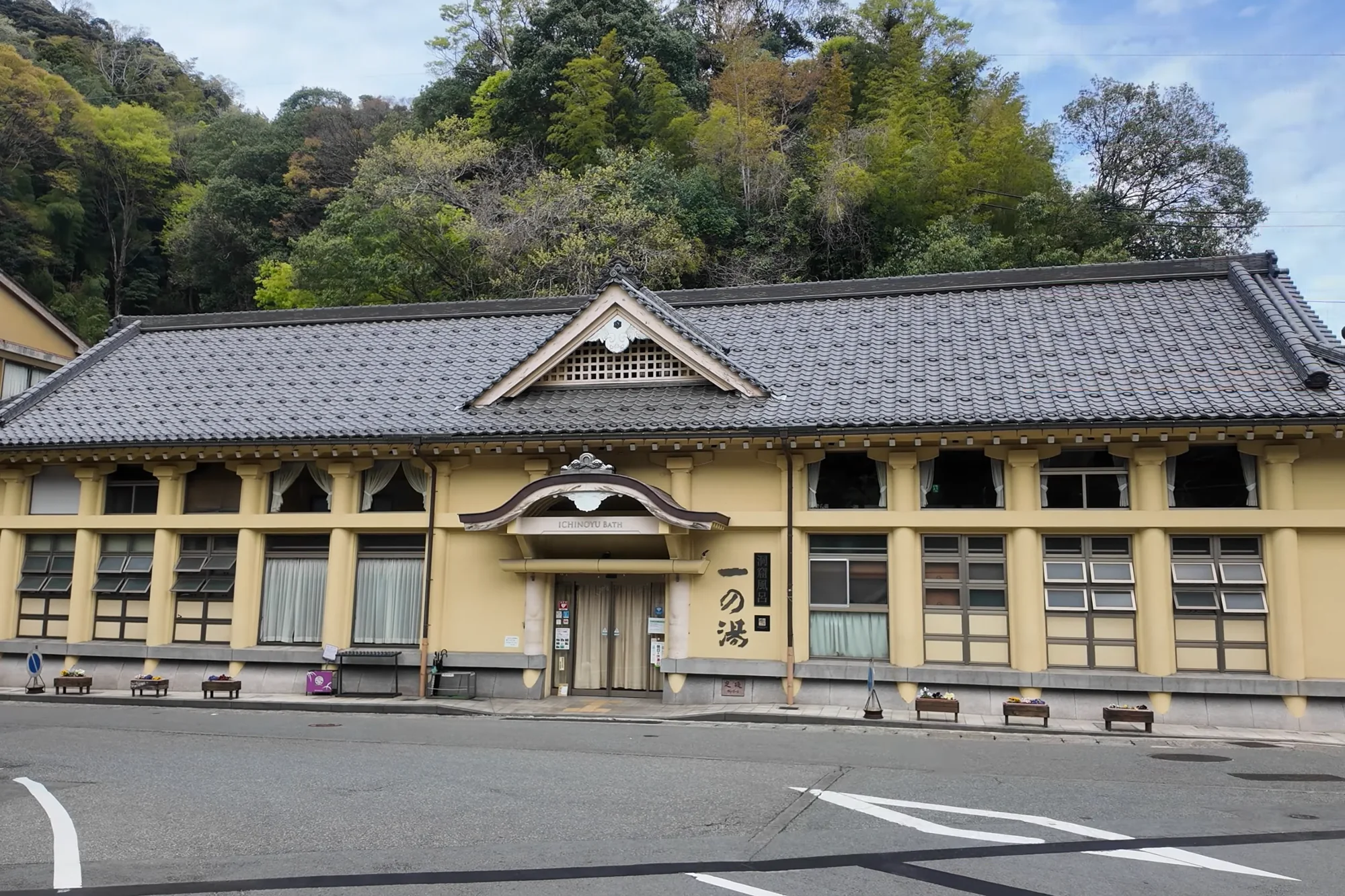
Ichi-no-yu: opens 7am, closes Wednesdays. The inner bath is cut into the rock behind the hall.
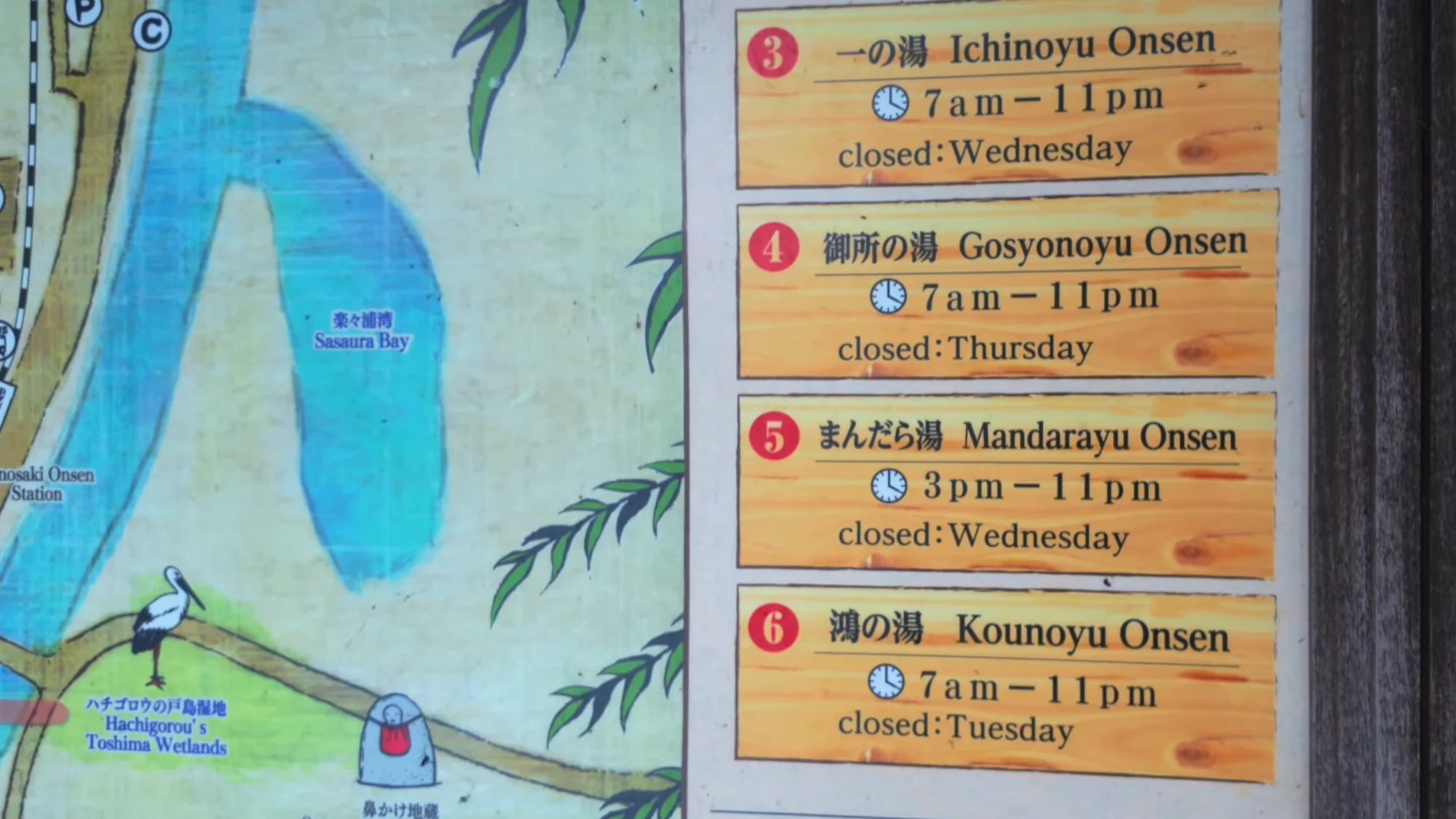
Closures are staggered across Monday, Tuesday, Wednesday and Thursday, so no single day shuts the circuit.
What do the bathhouse names and blessings actually mean?
Each of the seven carries a ご利益 (goriyaku, the particular blessing that bath is said to confer), and the roster is older and better documented than the tourist map lets on. Ichi-no-yu (一の湯), the kabuki-fronted showpiece, is the bath of exam success, road safety and general good fortune — and its name is a boast with a paper trail. In the mid-Edo period it was called Ara-yu (新湯, "the new bath") until 香川修徳 (Kagawa Shūtoku), one of the most famous physicians of the age, wrote in his pharmacology text 一本堂薬選 (Ippondō Yakusen) that Kinosaki's new bath was 天下一 — first under heaven. The town renamed the bath after the compliment. The "one" in Ichi-no-yu means number one. Goshono-yu (御所の湯, "the palace bath") takes its name from the 増鏡 (Masukagami), a fourteenth-century court chronicle, which records that 安嘉門院 (Ankamon'in), elder sister of Emperor Go-Horikawa, bathed here in 1267 (文永4年). It doubles as the 美人の湯 (bijin no yu, "beauty bath") and carries blessings for good matches and protection from fire. Yanagi-yu (柳湯, "the willow bath"), smallest and reputedly hottest, is said to have welled up beneath a willow transplanted from the shores of China's West Lake; its blessing is fertility and safe childbirth. Jizō-yu (地蔵湯) is named for a statue of the bodhisattva Jizō said to have emerged from its spring source — still enshrined on the grounds — and in the Edo period it was known as the commoners' bath, which it culturally remains: this is the house where you are most likely to soak beside someone who lives up the lane. Mandara-yu (まんだら湯) marks the spot where the founding prayer was answered, and Kou-no-yu (鴻の湯), oldest of the seven, is the stork's own bath, blessing married harmony and long life. Complete the circuit, the tourism association likes to point out, and you have covered luck, love, childbirth, marriage, longevity and prosperity in seven tubs of the same water. Few stamp rallies anywhere promise a fuller life.
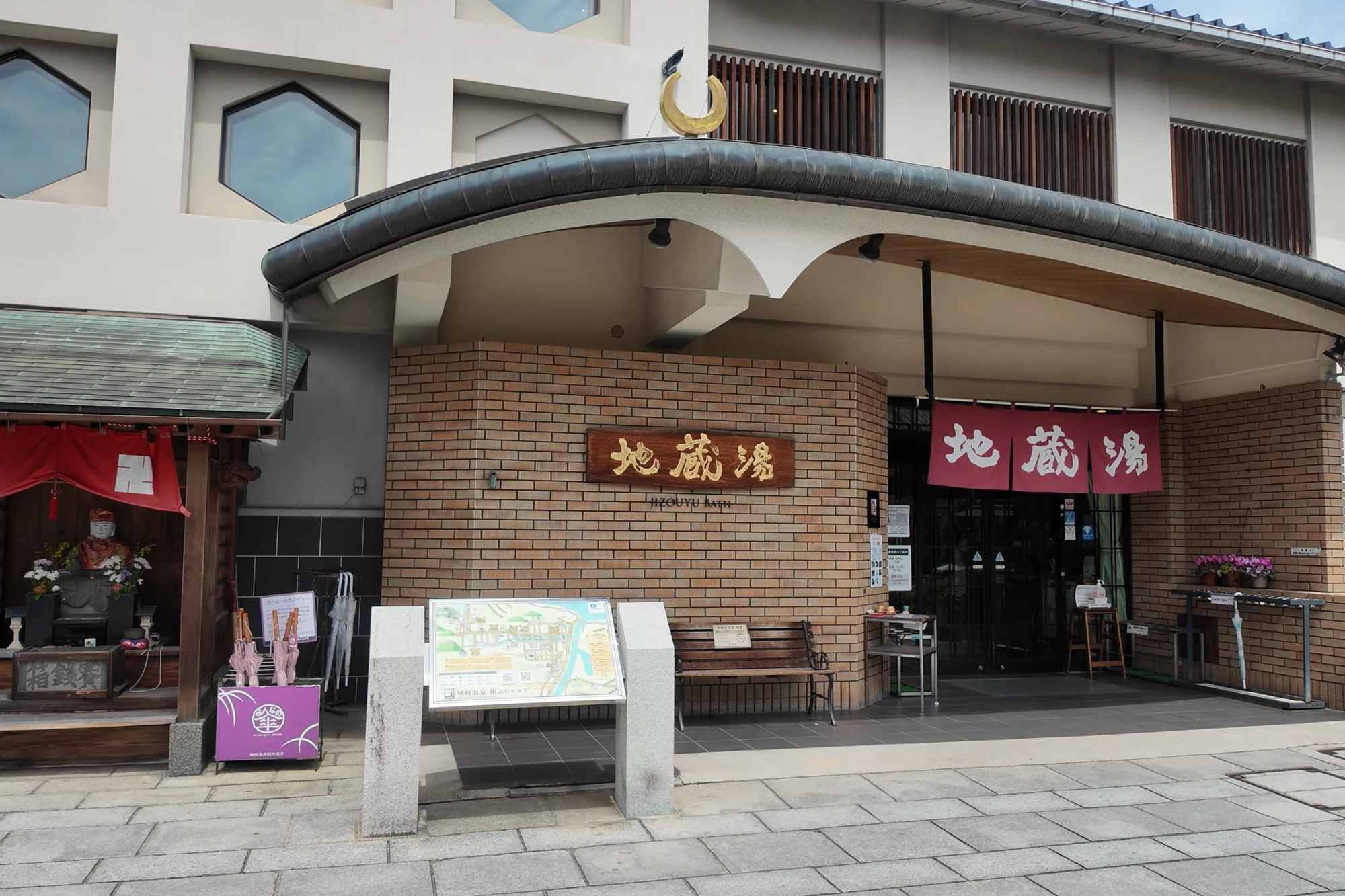
Each house carries a different goriyaku — the blessing it is said to confer. Jizo-yu's is safe childbirth.
Is the water actually the same in all seven bathhouses?
Yes — and Kinosaki is unusually honest about it. All seven houses draw the same municipally managed spring water, classified as ナトリウム・カルシウム塩化物泉 (sodium-calcium chloride spring) by both the city and the 日本温泉協会 (Nihon Onsen Kyōkai, the Japan Spa Association), and served at around 42°C (108°F). Chloride springs are the ones bathers describe as warming: the dissolved salts slow evaporation from the skin, so the heat stays with you on the walk between houses — which, in a town built around walking between houses, is not a small design detail. The differences you feel from bath to bath are architecture, light and company, not chemistry, and the town says so plainly, which almost no multi-bath destination does. Since December 2023 (令和5年12月) the town has gone a step further, posting a 城崎温泉天然温泉配湯の証 (certificate of natural hot-spring distribution) at facilities using the genuine spring water, so you can check at the door. The springs are managed collectively by 城崎町湯島財産区 (the Kinosaki-chō Yushima property ward), a municipal body, rather than owned bath by bath — the same collective structure the ordinance protects. The source runs far hotter than the tubs: about 57°C (135°F) at the town's three 飲泉所 (insenjo, drinking fountains), where you can drink the mineral water as well as bathe in it. One stands in front of the station, one at the Ō-bashi bridge by Ichi-no-yu, one in Yakushi Park below the temple. The city publishes an actual dosage register for drinking: 100–150 ml (3–5 fl oz) per serving, no more than 200–500 ml (7–17 fl oz) a day, ideally about thirty minutes before a meal, with under-15s only under a doctor's guidance; the listed traditional indications are atrophic gastritis and constipation, in the balneological register, which is not medical advice. Taking the water home is prohibited. Hot mineral water you can legally drink, free, from a fountain in front of a train station — most visitors walk past all three without ever knowing they are there.
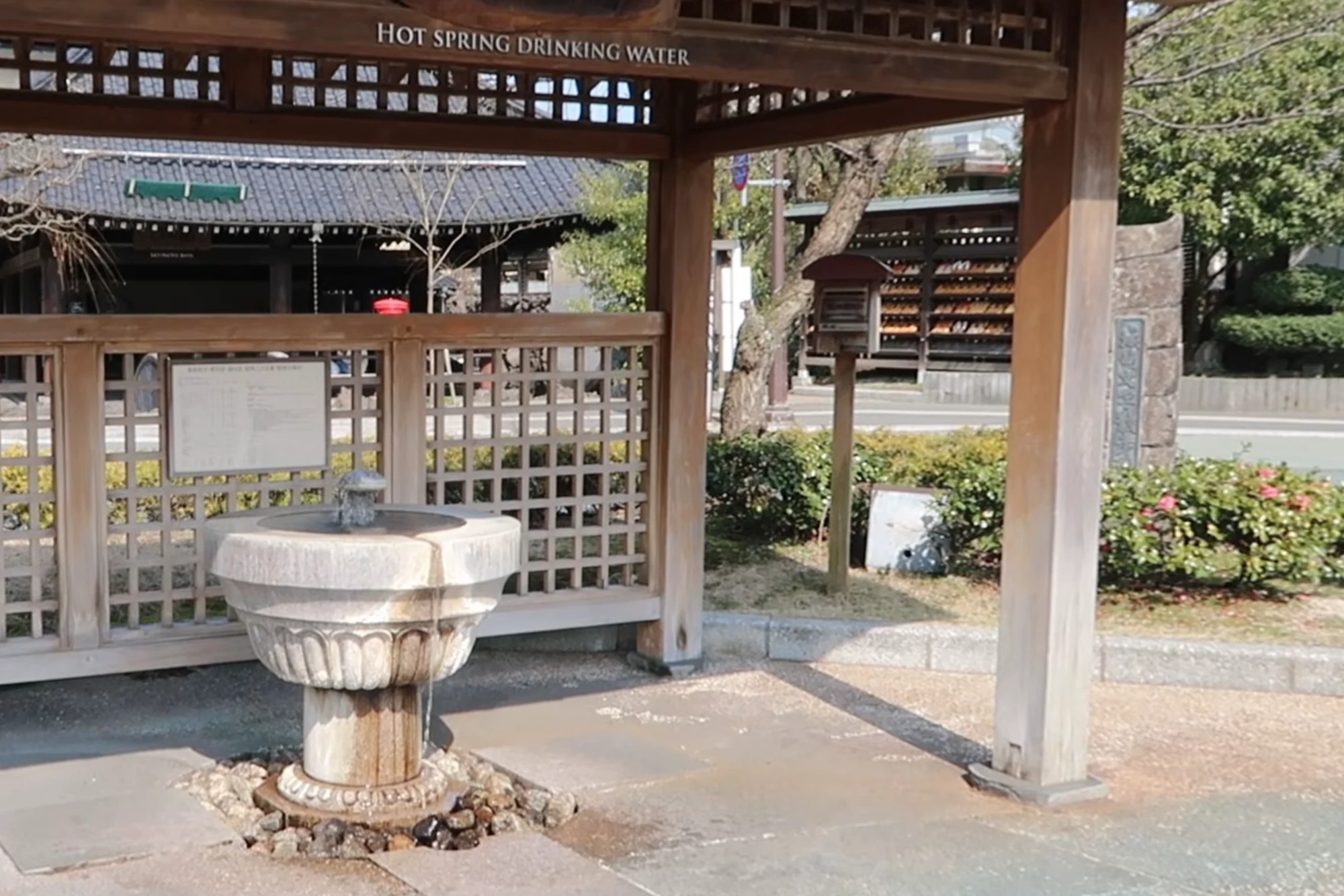
Yes. All seven share one spring quality; the differences are architectural, not chemical.
Which bath should you pick if you only have time for one?
An honest ranking question deserves an honest answer, with the caveat that "best" here means best for a first-timer with one slot. Goshono-yu is the consensus pick and ours too: palace-style architecture, and an open-air bath set against a hillside waterfall that is worth the trip on its own. If its queue is long — it happens on winter weekends — Ichi-no-yu is the closest experience swap, with the cave bath carved into the rock behind its kabuki-theatre façade. If what you want is quiet rather than spectacle, Jizō-yu, the locals' lantern-shaped bathhouse, is the honest choice, and arguably the most Kinosaki of the seven precisely because nothing about it performs. Time of day matters nearly as much as the pick. At 7:00 (7 am) the same houses that queue at 20:00 (8 pm) are close to empty, and a morning Goshono-yu with mist on the waterfall garden beats an evening one with a line out the door. Kou-no-yu would have been the connoisseur's answer — garden rotenburo, the stork legend, the quiet western end — but it is closed for renovation works, reopening expected November 2026 (⚠️ confirm before travelling with it in mind). When it reopens, that is what your second slot is for.
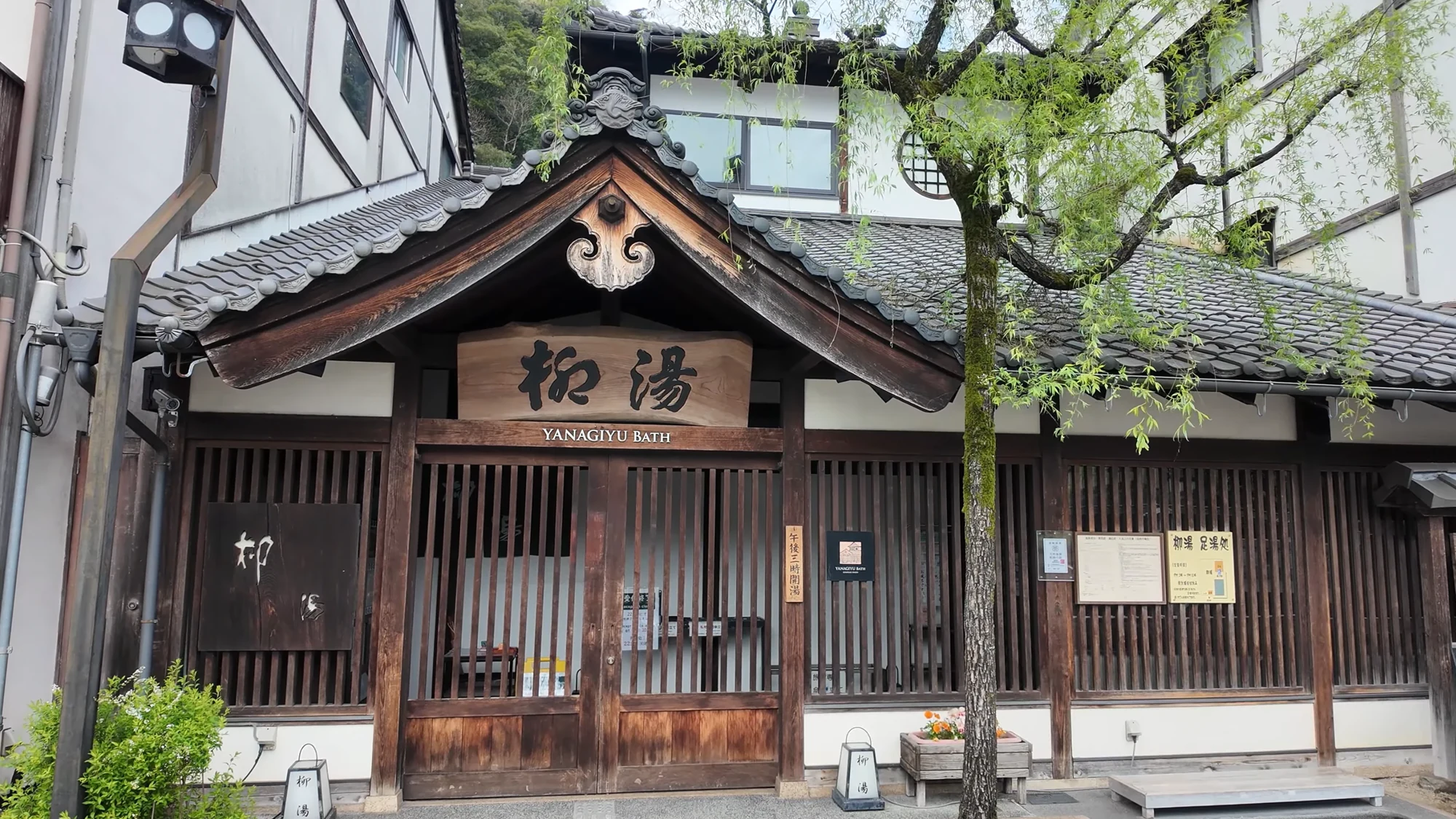
Two closures do not break the system — the rota was always designed so no single day shuts the town.
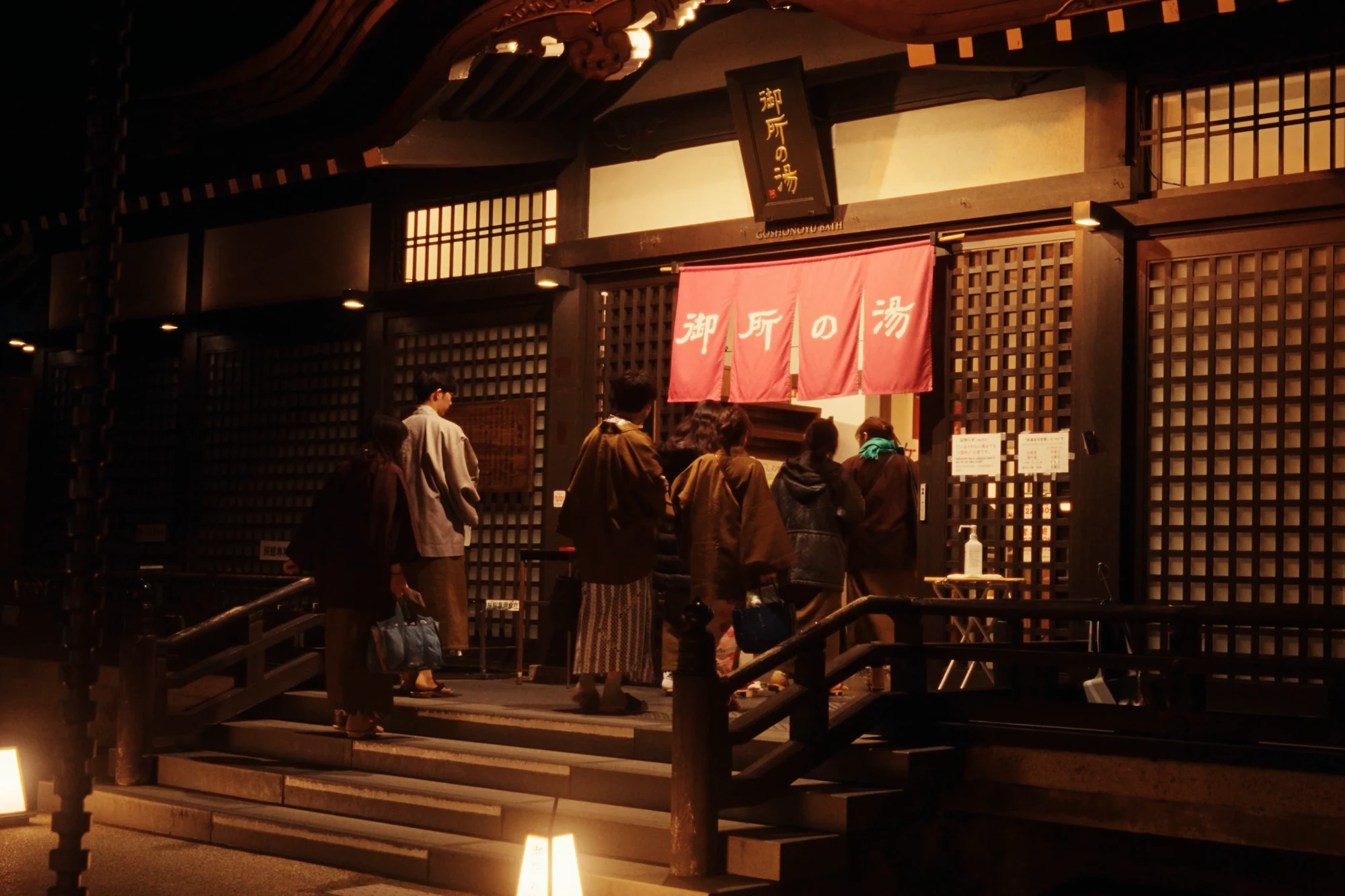
If it is one bath only, make it Goshono-yu for the waterfall, or Ichi-no-yu for the cave.
When to go: crab, snow, and blossoms
Winter is the headline season, and it earns the title. Matsuba crab (松葉ガニ, Matsuba-gani), the prized snow crab of the San'in coast, comes into season in early November and runs to late March, and Kinosaki ryokan build their winter kaiseki dinners entirely around it, serving it as sashimi, grilled, boiled, and in hot pot. Pair that with an outdoor bath in cold air, sometimes under falling snow, and you have the version of Kinosaki that fills every poster. Winter weekends book out months ahead, and crab pushes dinner-inclusive rates to their annual peak. Spring trades crab for cherry blossom along the canal in early April, longer light, and rates that settle back to normal. Summer brings yukata-clad festival crowds, fireworks, and Takeno Beach a short train hop away, with baths that feel more refreshing than warming. Autumn lights the gorge around the ropeway and offers the calm shoulder weeks of October, arguably the best value of the year. The one stretch to plan carefully is the New Year holiday, roughly December 29 to January 3, which sells out at premium prices. Midweek in any season, the town breathes easier. Two calendar anchors are worth pinning before you book. Matsuba crab season opens November 6 and runs to late March — our crab-season and autumn guides cover the opening weeks, when the first boats land at the San'in ports and the town's menus change overnight. And in late April the town holds the 温泉まつり (Onsen Matsuri, the hot-spring festival), honouring the founding monk — the one date on the calendar when Kinosaki celebrates the water itself rather than what swims in it. Spring's willows and cherry blossom along the canal, and the festival, each have their own guide.
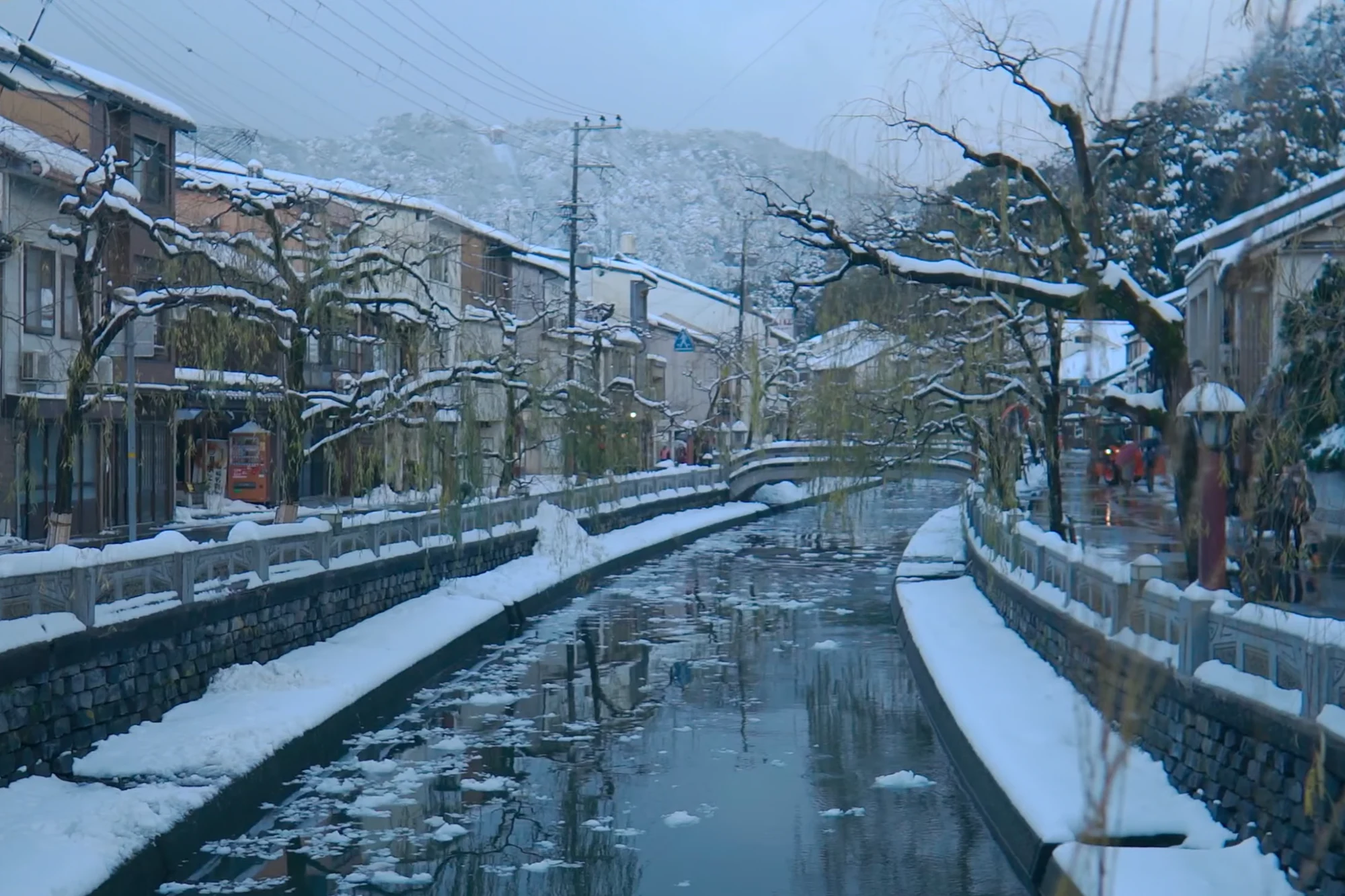
Crab from November, snow in January, blossom in April. There is no wrong month, only different ones.
How long you need
A day trip is possible from Osaka or Kyoto, but it undersells the place, because the best hours belong to people who stay. After the day visitors leave in the late afternoon, the lanterns come on and the streets fill with overnight guests drifting between baths in yukata. One night buys the full ritual: arrive mid-afternoon, take a first bath before dinner, eat kaiseki at your inn, walk the lantern-lit circuit until the bathhouses close, and fit a quiet soak in before breakfast. Two nights turns the ritual into a proper holiday, with room for the ropeway up to Onsenji, the basalt columns of Genbudo one stop down the line, or Takeno Beach in summer. Three or four baths a day is a comfortable pace; seven in one evening is a stamp rally, and several houses run hot.
What does the first evening actually look like?
Arrive mid-afternoon and the ritual runs itself. Check-in comes with a yukata fitting — inns keep racks of sizes and patterns, and staff will tie the obi properly — and a pair of geta for the street. As of this writing the morning houses, Ichi-no-yu, Goshono-yu and Jizō-yu, open at 7:00 (7 am), while Mandara-yu and Yanagi-yu open at 15:00 (3 pm), all running to 23:00 (11 pm) with last entry thirty minutes before close (⚠️ hours shift — the association posts a live bath-status page). So the classic first move is one of the afternoon houses: Mandara-yu, the origin-point bath with its hillside rotenburo, opens at almost exactly the moment you are standing in a fresh yukata wondering where to start. One bath before dinner is the right number. Kaiseki at a Kinosaki ryokan is long, deliberate and the financial centrepiece of the trip; arrive hungry and unhurried. Afterwards the town is at its best — lanterns on, the canal black and glassy, geta clattering on every bridge — and the evening circuit begins. Two or three houses between dinner and closing is a comfortable pace. The etiquette is simple: wash seated before entering the tub, no towels in the water, no photography inside, and hydrate between houses — the drinking fountains exist for a reason. Leave anything still on your list for the morning; the early houses open at 7:00, and a near-empty bath before breakfast is a better final memory than a rushed seventh stamp the night before. Two details first-timers miss. Every house lends or sells towels at the door, so you can bathe on impulse without carrying anything. And your pass works from the moment of check-in, not from evening — early arrivals can fit a first bath before the streets fill with yukata at all.
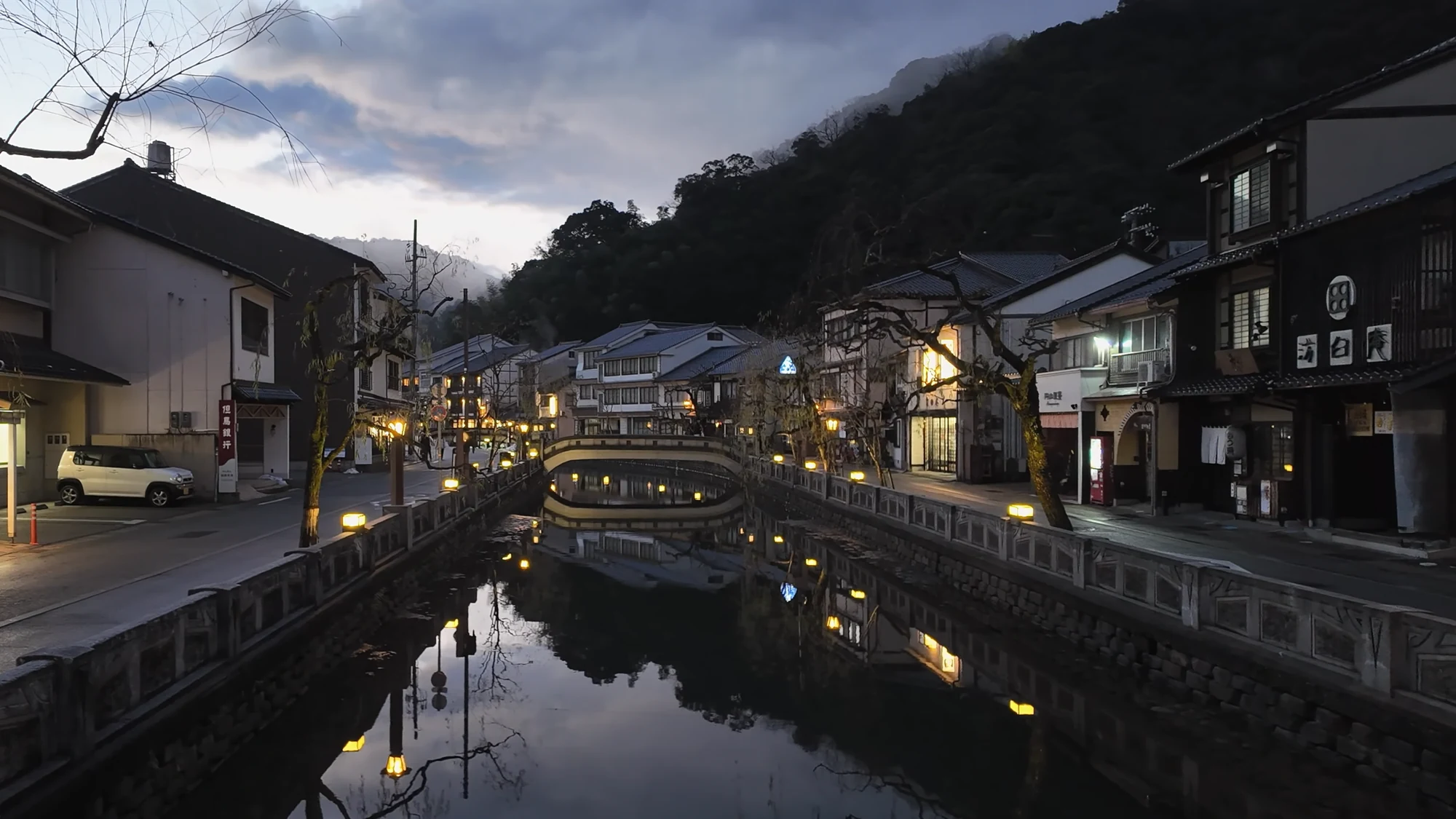
The first evening is the whole argument for sleeping here rather than visiting.
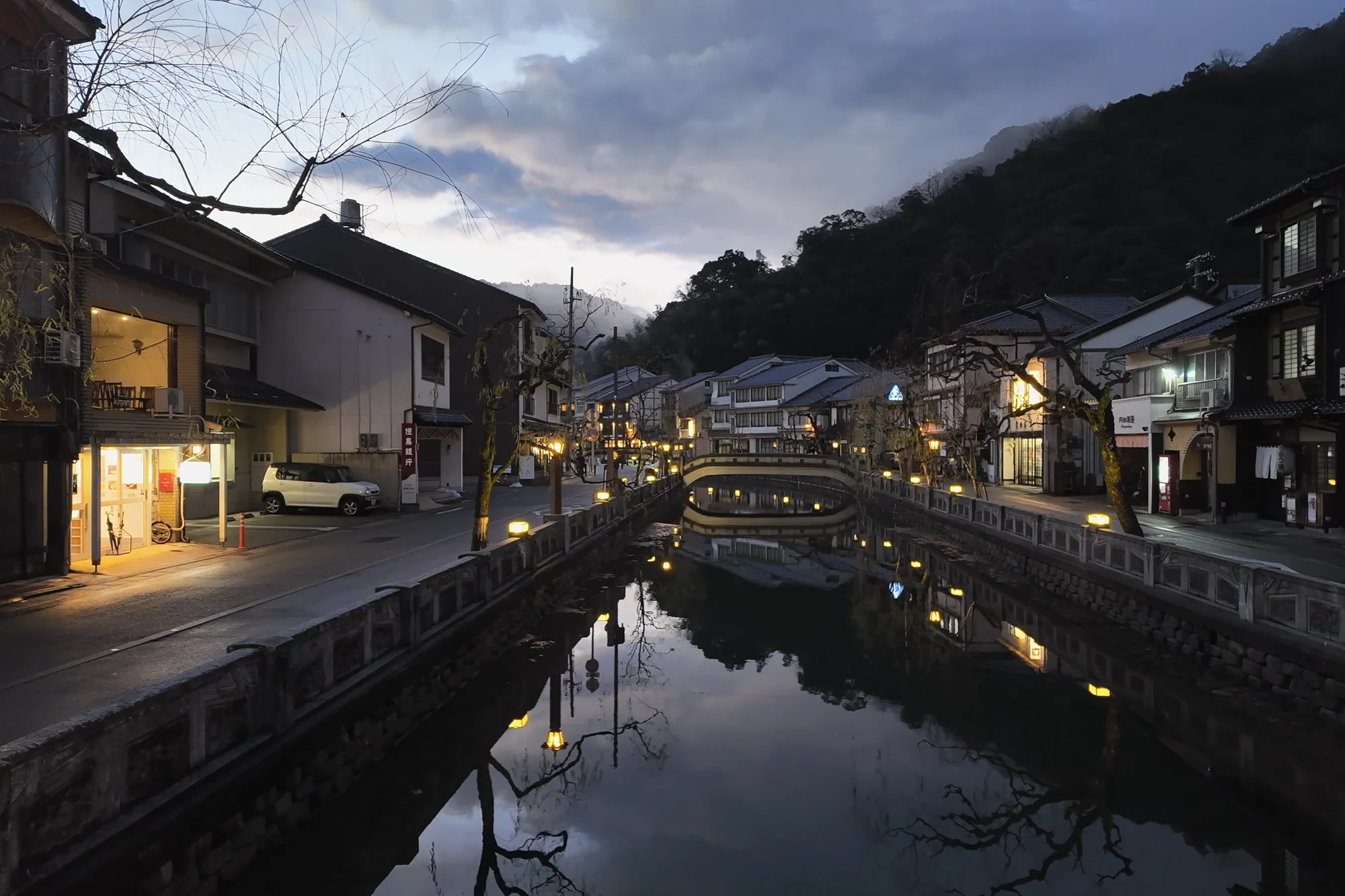
The lantern circuit starts as the light goes; the bathhouses run to 11pm with last entry at 10:30.
Getting there without a car
Kinosaki is genuinely easy to reach by train, and a car is more liability than help once you arrive. From Osaka, the Limited Express Kounotori runs direct to Kinosaki Onsen Station in about 2 hours 40 minutes, one way. From Kyoto, the aptly named Limited Express Kinosaki runs direct in about 2 hours 20 minutes, though only around five times a day, so your departure shapes your morning. From Tokyo there is no single train: take the Tokaido Shinkansen to Kyoto, then change for the Limited Express Kinosaki, for a total of 5 to 6 hours, which is why Kinosaki belongs in a wider Kansai itinerary rather than a standalone trip from Tokyo. The whole route is JR, so a Japan Rail Pass or a Kansai-area pass applies. The station faces the foot of the main street, Satono-yu is right beside the exit, and every ryokan is a 5 to 15 minute walk, with many sending a shuttle or a luggage cart.
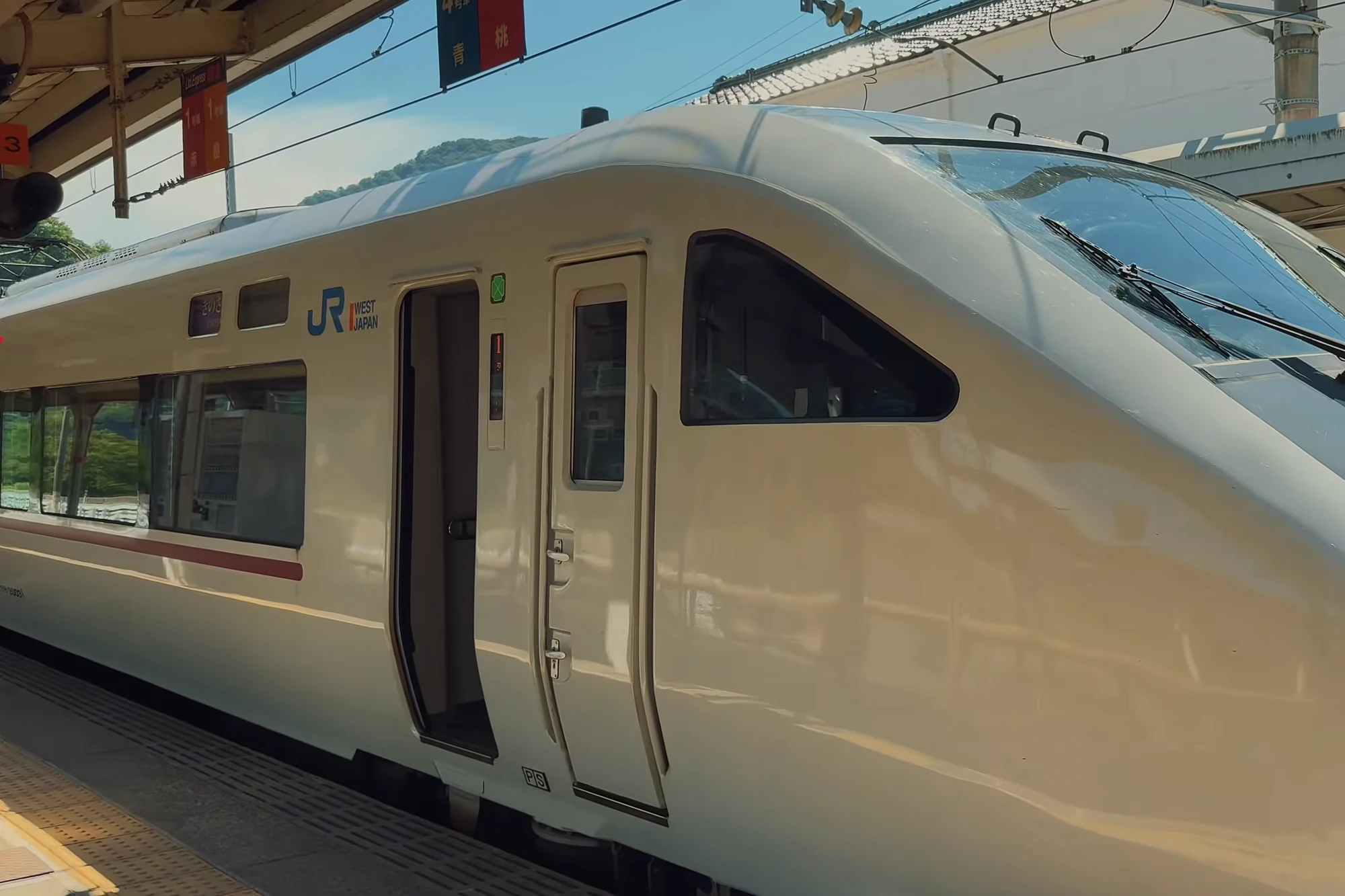
Direct from Shin-Osaka in about 2 h 40 min, from Kyoto in about 2 h 20 min. No change either way.
Where to stay
Stay inside the town. That single decision unlocks the free bath pass, the yukata, and the after-dark life that is the reason to come. The station end is convenient and close to shops and restaurants. The middle of town along the canal is the photogenic heart. The western end near Kou-no-yu and the ropeway is the quiet choice. Most ryokan sell rooms with kaiseki dinner and breakfast included, and in crab season that dinner is the event. For deeper help choosing, see our where to stay overview, plus the luxury and budget guides.
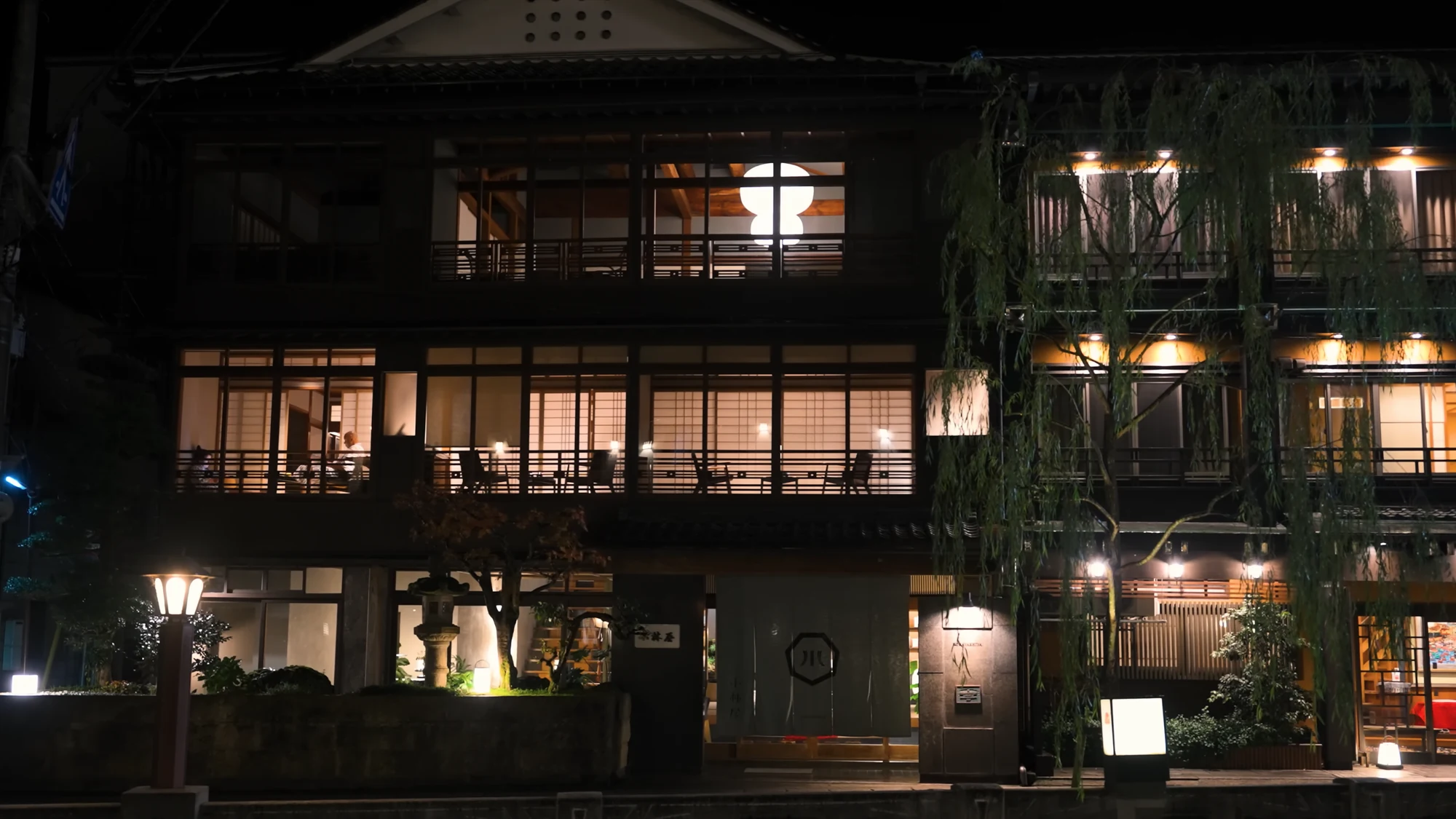
Twenty-odd inns line one street. Choosing between them is a question of room and meal, never of bath.
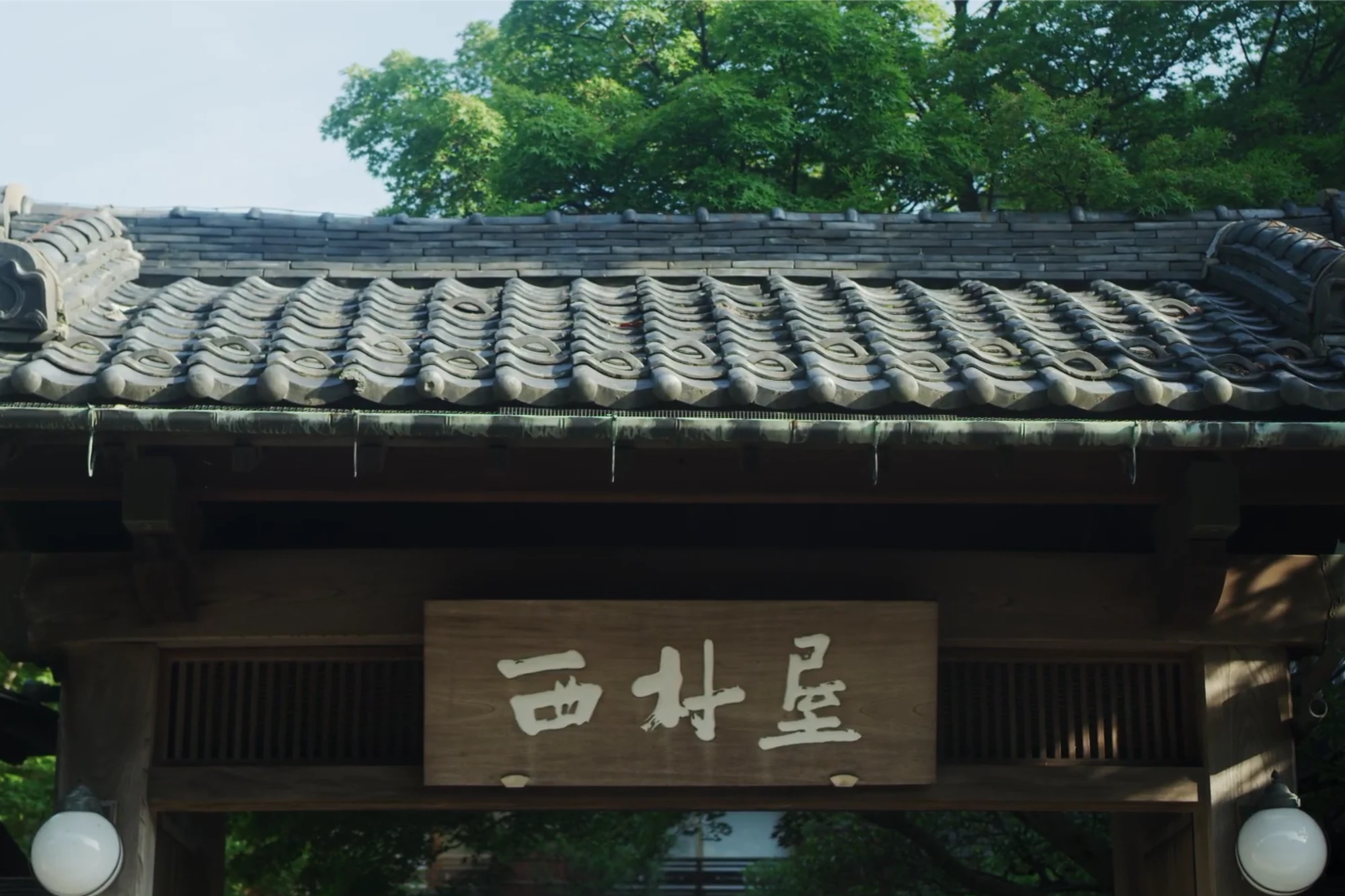
Every bed in the centre of town is a ryokan. There is no hotel district.
What does a Kinosaki trip actually cost?
The economics of the town are upside down compared with most famous destinations: the headline experience is nearly free, and the money goes to dinner. The seven-bath circuit costs nothing beyond your room if you stay overnight, thanks to the guest pass; a day visitor pays ¥1,500 (about US$10) for the day pass, and the door price for a single bath is ¥800 (about US$5.30) for adults, ¥400 (about US$2.70) for children. Walk into two baths and the pass has paid for itself — arithmetic the pass exists to make obvious. The real spend is the inn, and it is worth reframing what that buys. A Kinosaki room typically comes with kaiseki dinner and breakfast included, so the rate is closer to dinner-and-lodging than to a bare hotel room — and in crab season, early November to late March, 松葉ガニ (Matsuba-gani) pushes dinner-inclusive rates to their annual peak, because the crab is the show. ⚠️ Exact rates move with season, day of week and exchange rate; our where-to-stay, luxury and budget guides break down the current bands and where the value hides. Getting here is the other fixed line: a reserved seat one way from Osaka on the direct limited express — unreserved a little cheaper — and similar from Kyoto — and then nothing once you arrive. No taxis, no buses, no rental car, because the town itself is the corridor. A rail pass that covers the route wipes that line out entirely. After that the incidentals are small and pleasant: a towel at a bathhouse door, coffee by the canal, whatever the evening shops talk you into. The ordinance that keeps the baths public also keeps the main event off the meter — which is why a Kinosaki night, crab aside, undercuts most famous-name onsen towns at comparable comfort.
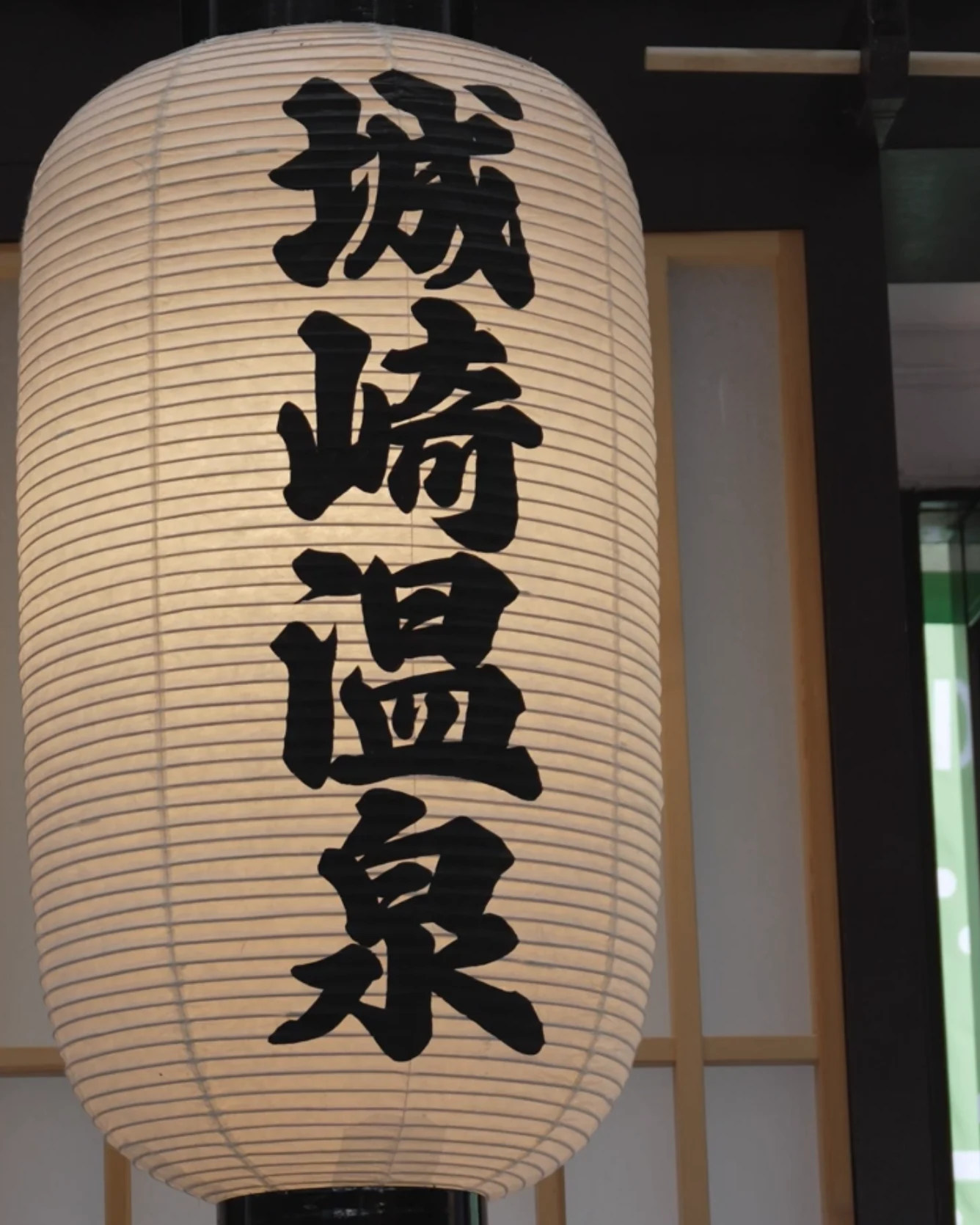
Budget roughly ¥20,000–40,000 per person for a night with dinner, more in crab season. ⚠️
How does Kinosaki compare with Japan's other famous onsen towns?
Fairly — and it wins on a dimension the others do not contest. Arima (有馬温泉), an hour from Osaka against Kinosaki's 2 hours 40 minutes, has older imperial credentials and its celebrated gold and silver waters, but it is a steep resort of inns you stay inside, not a town you bathe across: no circuit, no shared pass, no ordinance holding the public baths at the centre of town life. Our Kinosaki-versus-Arima guide runs the full comparison; the short version is go to Arima for the water, go to Kinosaki for the town. Kusatsu (草津温泉) — by its own town's careful phrasing 自然湧出量日本一, Japan's largest natural free-flowing hot-spring volume — beats Kinosaki on sheer thermal drama, steam rising off the yubatake at its heart. But Kusatsu is a mountain resort you contemplate; Kinosaki is a street you wear. Ginzan (銀山温泉) photographs better in the snow, one perfect Taishō-era lane of wooden inns, and is a fraction of Kinosaki's size — a set piece rather than a working town. What none of them offers is Kinosaki's structural bet: a legal arrangement that makes the whole town, not any single inn or spring, the destination. Two practical tiebreakers push the same way. Kinosaki is the most openly tattoo-friendly of Japan's famous onsen towns — all seven public baths admit tattooed bathers with no stickers, size limits or special hours, a policy none of the others has matched town-wide. And it is genuinely car-free in practice: arrive by direct train, walk everything, leave. If your Japan trip already includes Kansai, no other major onsen town delivers this much of the classic postcard — yukata, geta, lanterns, crab — with this little logistical friction.
Why does the town look the way it does? The 1925 earthquake
The lantern-lit streetscape reads as centuries old. Most of it is dated 1926–1935, and the reason is the town's darkest year. In May 1925 (大正14年) the 北但大震災 (Kita-Tajima earthquake), a magnitude-6-class quake on this coast, destroyed Kinosaki twice over — first the shaking, then the fire that followed it through the wooden town. The springs survived. The town did not. What happened next explains the place you will walk through. The mayor, 西村佐兵衛 (Nishimura Sahei), rallied the reconstruction around a decision that tells you everything about this town's priorities: the bathhouses came first. Six sotoyu were rebuilt between 1926 and 1932, ahead of much else, while a land-readjustment plan redrew the streets, and by 1935 the framework of today's townscape — the canal, the low stone bridges, the spacing of the bathhouses along the lane — was complete. Ichi-no-yu went up in 1926 in reinforced concrete, a deliberate firebreak in a town that had just burned; when the bath was rebuilt again in 1999, that concrete-era façade was kept. So the "timeless" street is really a considered street: a town that, handed a blank slate by catastrophe, chose to rebuild itself as a bathing town first and everything else second. Towns usually rebuild after disasters around their stations, their markets, their mills. Kinosaki rebuilt around seven public baths — the same ranking of priorities its ordinance holds in law. The earthquake did not create Kinosaki's identity so much as reveal it, at the one moment the town could have become anything, and chose to become itself again, deliberately. Our founding-and-history guide carries the full chronology.
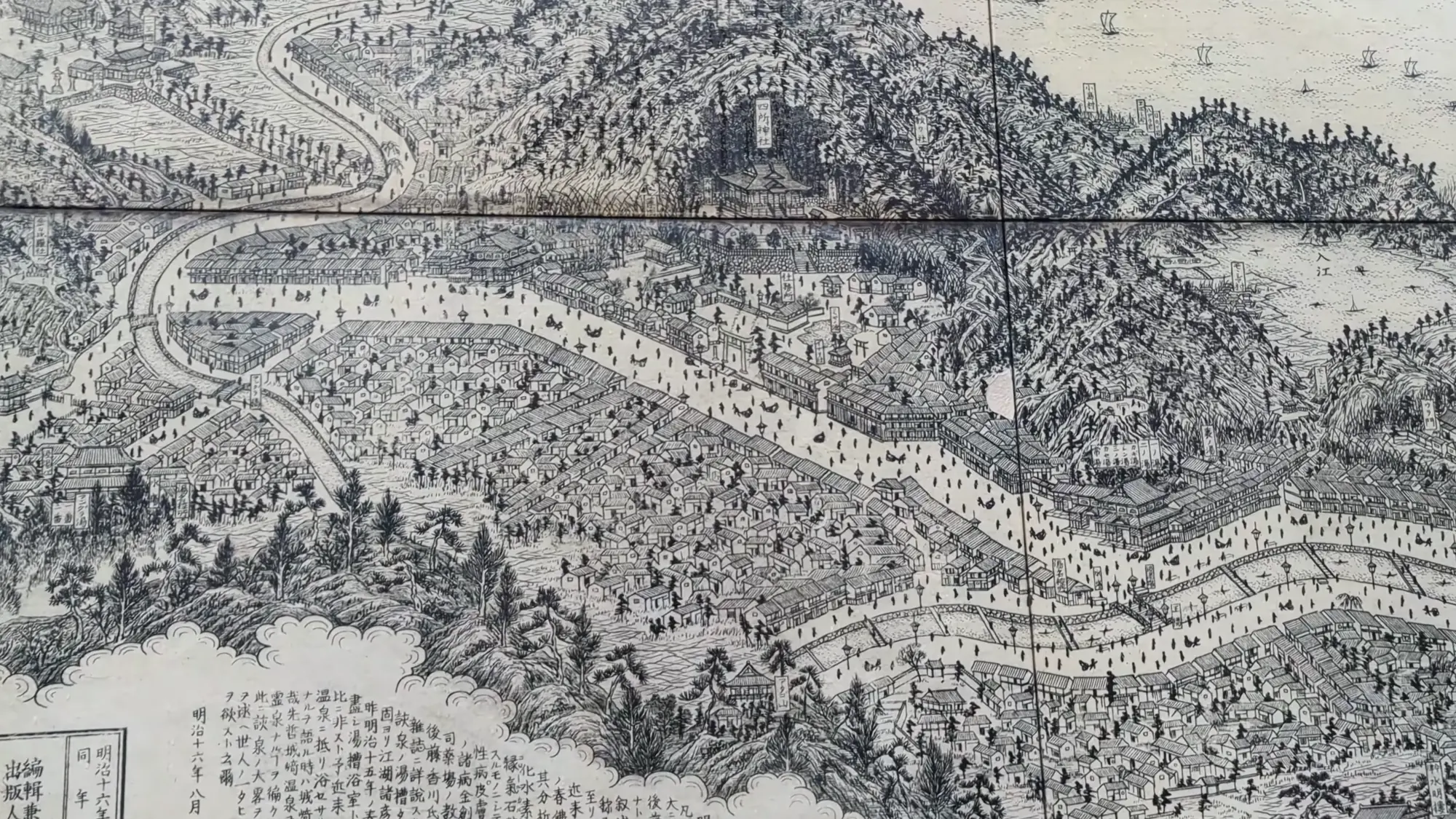
The 1925 Kita-Tajima earthquake and the fires after it destroyed the town. What stands now is the rebuild.
Why is Kinosaki famous in Japanese literature?
Ask a Japanese traveller what they associate with Kinosaki and there is a fair chance the answer is homework. 志賀直哉 (Shiga Naoya), one of the defining figures of modern Japanese fiction, convalesced here and turned the stay into 城の崎にて (Kinosaki nite, "At Kinosaki," 1917), a short story so canonical that generations of students meet this town on the page before they ever see the canal. The tourism association dates the literary habit far earlier — verses about these springs survive from the Heian period (794–1185) — and today the town maintains 23 文学碑 (bungakuhi, literary monuments), from 松尾芭蕉 (Matsuo Bashō) at the Tsukimi bridge to 与謝野晶子 (Yosano Akiko) beside Ichi-no-yu, walkable as a marked course in one to two hours. The Shiga monument, in front of the town's literary museum, has the best story of the twenty-three. Shiga disliked monuments to himself and initially refused this one; local persistence won him over, and he supplied his own signature for the stone — making it, by the association's account, the only Shiga Naoya monument in Japan in the author's own hand. The museum itself, the 城崎文芸館 (Kinosaki Bungeikan, branded KINOBUN), opened in 1996 and was strikingly redesigned in 2016 around its Shiga and 白樺派 (Shirakaba-ha, White Birch school) holdings. (⚠️ The museum posted a temporary-closure notice on September 11, 2026 — check current status before planning around it.) And the habit is still alive, which is the remarkable part. Under the town's Books & Onsen imprint, 万城目学 (Makime Manabu) wrote 城崎裁判 (Kinosaki Saiban, "The Kinosaki Trial") retracing Shiga's footsteps, printed on waterproof stone paper so it can be read in the bath, and 湊かなえ (Minato Kanae) wrote 城崎へかえる (Kinosaki e Kaeru, "Returning to Kinosaki"), sold in a jacket textured like crab shell. A town that commissions living novelists, prints the results bath-proof and sells them at the inns is not trading on a dead reputation. Our literary guide tells the whole story, monument by monument.
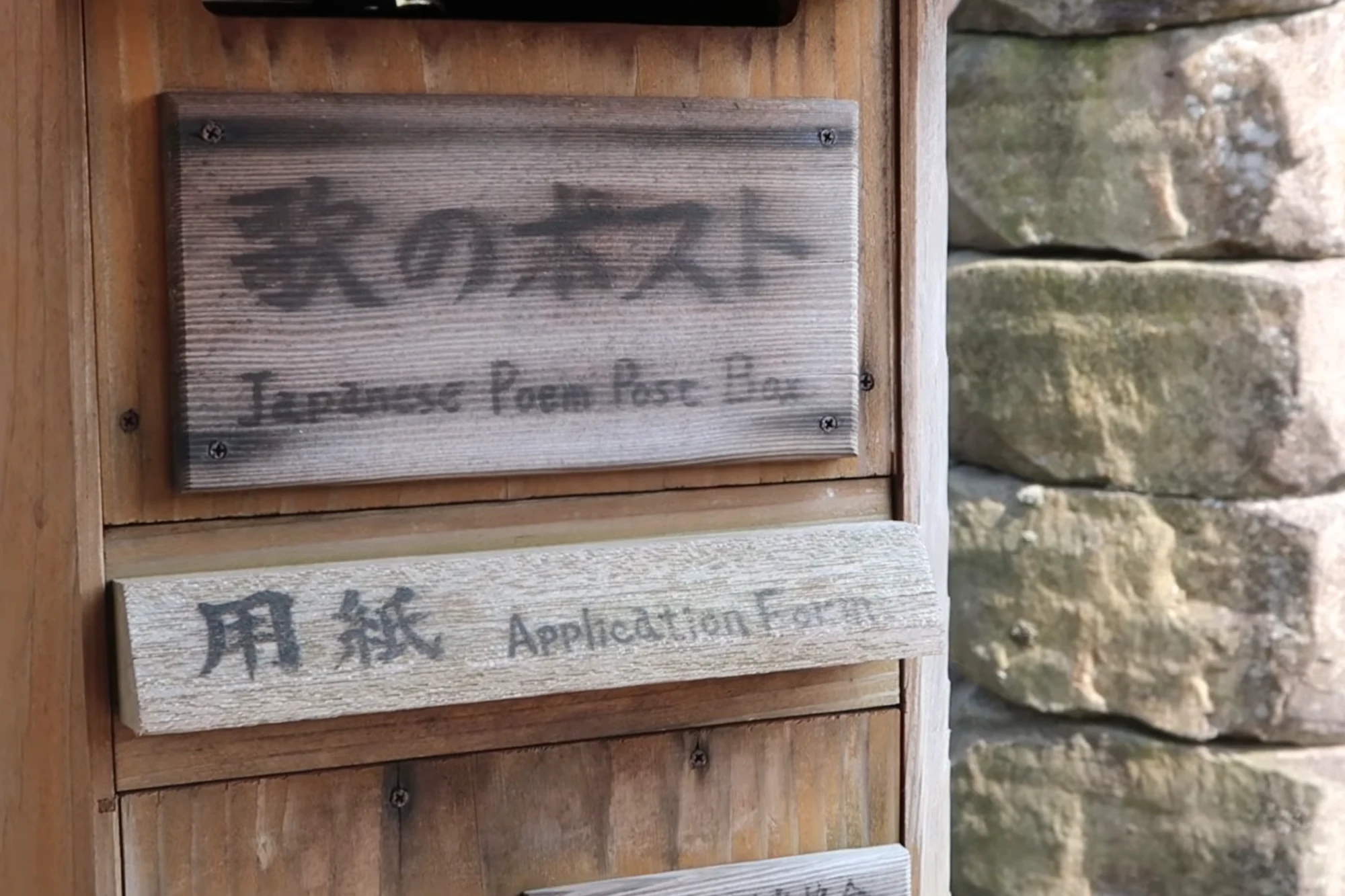
Twenty-three stone monuments stand around the town, one of them signed by Shiga Naoya himself.
Where to Stay
Stay the night. The town turns to yours after dark. Day visitors leave by mid-afternoon, and that is when the lanterns come on and the canal fills with guests drifting between baths. That hour belongs to people who stay, with your own ryokan bath waiting at the end of it.
*Find a Kinosaki ryokan →*
Tips
Plan your bath circuit around the weekly closing-day calendar — each sotoyu closes one day a week on staggered days.
Stay the night: the lantern-lit evening circuit and quiet morning soaks belong to overnight guests.
Three or four baths a day is a comfortable pace; seven in one evening is a stamp rally, and several houses run hot.
Book November–March weekends months ahead — crab season is the annual booking peak.
Skip the car: the station faces the main street and every ryokan is a 5–15 minute walk.
Try a 飲泉所 (insenjo, drinking fountain) — station front, Ō-bashi by Ichi-no-yu, or Yakushi Park; 100–150 ml about 30 minutes before dinner is the published serving.
Kou-no-yu is closed for renovation until about November 2026 and Satono-yu closed since April 2024 — check the association's live bath-status page before promising anyone a specific bath.

Verified by The Japan Onsen Society
Show all sources
Verified July 7–16, 2026; bathhouse detail and literary sources verified September 22, 2026. Primary Japanese sources:
外湯めぐり発祥の地!温泉天国★城崎温泉 — 豊岡市観光公式サイト (Toyooka City Official Tourism Site): [https://toyooka-tourism.com/recommend/onsen/kinosaki_sotoyu/](https://toyooka-tourism.com/recommend/onsen/kinosaki_sotoyu/)
外湯 — 城崎温泉観光協会 (Kinosaki Onsen Tourism Association): [https://kinosaki-spa.gr.jp/about/spa/](https://kinosaki-spa.gr.jp/about/spa/)
城崎の歴史 — 城崎温泉観光協会 (Kinosaki Onsen Tourism Association): [https://kinosaki-spa.gr.jp/about/history/](https://kinosaki-spa.gr.jp/about/history/)
文学のまち — 城崎温泉観光協会 (Kinosaki Onsen Tourism Association): [https://kinosaki-spa.gr.jp/about/writer/](https://kinosaki-spa.gr.jp/about/writer/)
城崎温泉の【飲泉】 — 豊岡市観光公式サイト (Toyooka City Official Tourism Site): [https://toyooka-tourism.com/recommend/onsen/kinosaki_insen/](https://toyooka-tourism.com/recommend/onsen/kinosaki_insen/)
温泉地詳細〔城崎温泉〕 — 日本温泉協会 (Japan Spa Association): [https://www.spa.or.jp/search_p/detail_p/?F_ID=280880&pg=0](https://www.spa.or.jp/search_p/detail_p/?F_ID=280880&pg=0)
Related guides
The Town and Its Baths
The 7 bathhouses
Same water in all seven houses. What changes is the room, the story, and the blessing on the door.
The Town and Its Baths
Best time to visit
Crab from November, snow in January, willows in April. There is no wrong month, only different ones.
The Town and Its Baths
How long to stay
One night works, and most people do exactly that. Two nights is when the town stops being a stop.
The Town and Its Baths
Tattoo-friendly
All seven public baths admit tattoos, no cover-up required. Almost nowhere else in Japan does this.
The Town and Its Baths
The sotoyu system
The whole town is one ryokan. That is not a slogan about atmosphere. It is a description of the law.
The Town and Its Baths
Food Guide
Crab gets all the headlines. Tajima beef, Izushi soba and the town's own sweets deserve the rest.
The Town and Its Baths
Literary Kinosaki
Twenty-three stone monuments and one novelist's accident. This has been a town of writers for centuries.
The Town and Its Baths
1-Night Itinerary
One night in Kinosaki, hour by hour, from the train door to the last bathhouse before closing time.