Overview
Most travelers meet the yukata as hotel-room loungewear and wonder, reasonably, whether they are allowed to wear it past the lobby. Kinosaki exists to answer that question with the entire town. Here the yukata is the dress code: the lanes fill with them by late afternoon, the bathhouses assume them, and the sound of the town at night is geta on stone. The town's old saying calls clattering geta and yukata sleeves "the flowers of Kinosaki." This guide covers everything first-timers actually ask, how to put one on, what goes underneath, how men and women wear them differently, how to survive winter in cotton, and how to walk in wooden sandals without drama. Why this town, of all towns? Because Kinosaki engineered the conditions. A municipal ordinance keeps inn baths small so that the real bathing happens at the seven public houses — which means every guest must go outside, in whatever the inn dressed them in, and the inns have been dressing them beautifully for a century. The yukata is not a costume the town permits; it is the uniform its own law made necessary. The association leans into the identity from the top down: its official tourism-ambassador site lives at [kinosaki-yukata.com](http://kinosaki-yukata.com), and the summer calendar includes a ミスゆかたコンテスト (Miss Yukata contest). When a town's own institutions are named after the garment, you can stop wondering whether it is acceptable to wear one to dinner. Everything below assumes the inn's free kit; nothing needs buying, and nothing needs packing beyond what you already own.
What your inn gives you, and how to get dressed
At check-in or in your room you will find the kit: a cotton yukata (often a choice of patterns; ask at the desk for other sizes or designs, most inns keep a selection), an obi sash, a short haori-style jacket in cool weather, a padded tanzen overcoat in winter, tabi socks at some houses, and geta, the wooden sandals, by the door. Everything is included in the room rate; this is not a rental. Dressing takes ninety seconds once you know the order. Put the yukata on over your underwear like a robe. Wrap the RIGHT panel across your body first, then the LEFT panel over it, so the left lies on top and the opening faces your right hip. This is the rule that matters: left over right, always, for everyone; the reverse is how the dead are dressed for burial, and every Japanese person you meet will notice. Adjust the collar to sit at the back of the neck (women may pull it slightly lower), make the hem even at the ankles, then wrap the obi twice around your waist, men at the hips, women a little higher, and tie a simple knot, rotated to the back or side. If it loosens during the evening, retie it; everyone does. And if the diagram defeats you, ask at the front desk: dressing guests is a nightly routine at every inn in town, performed with practiced kindness. The whole operation, mirror check included, is faster than tying shoelaces once you have done it twice — and the mirror check is three items: nothing at the collar, left over right, hem at the ankle.
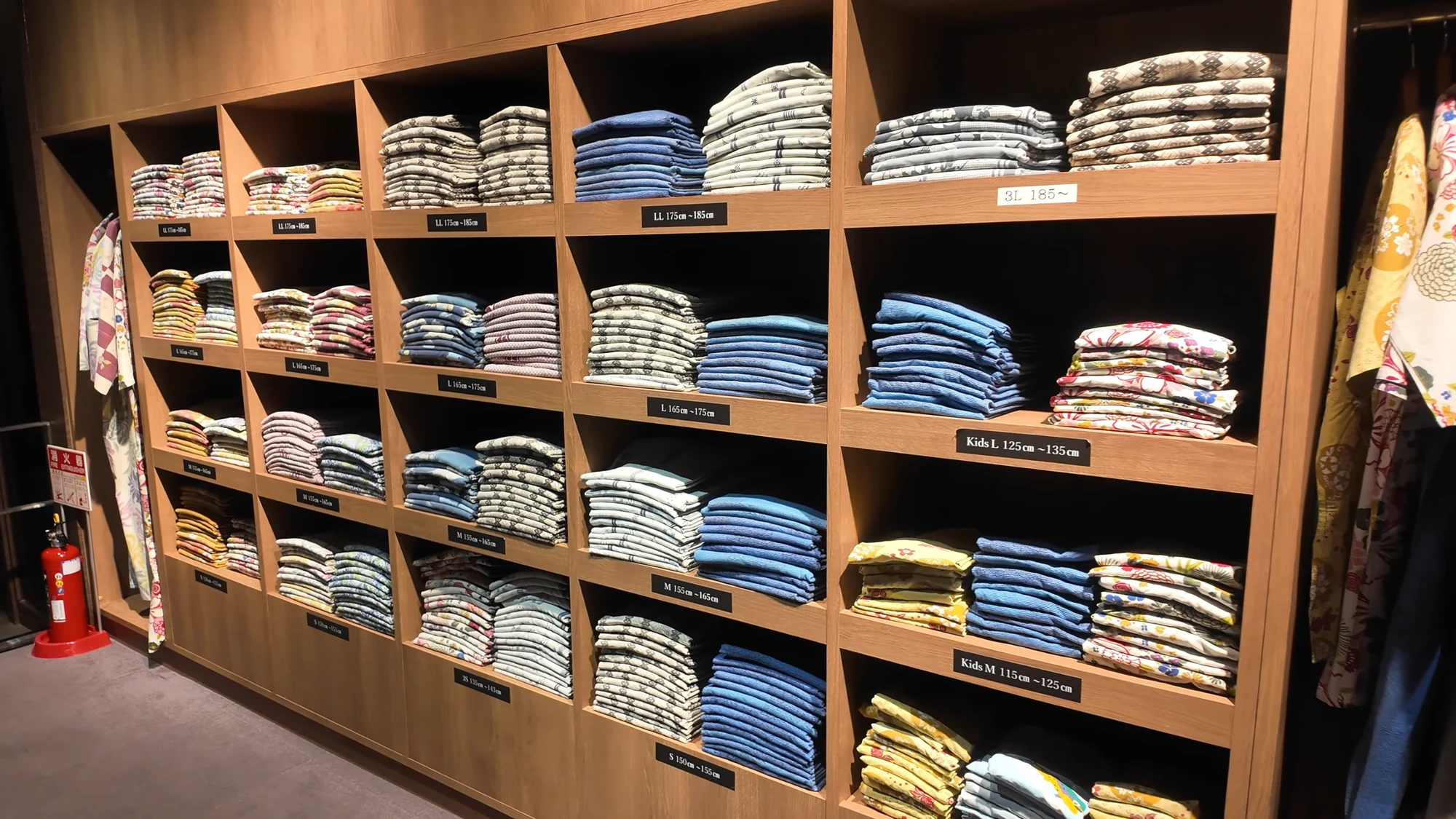
The yukata is free with the room. So are the geta, and in winter the padded tanzen over the top.
What do you wear under a yukata?
The question everyone searches and nobody asks aloud. Historically, very little: the yukata began as bathing wear, worn over bare skin or a thin under-robe (hadajuban) and, for women, a wrapped underskirt (koshimaki). Today the practical answer is simply your underwear, with a plain T-shirt or camisole optional in cold weather, kept low at the collar so it stays invisible. At the bathhouses the question resolves itself: you undress completely to bathe, so the yukata functions as the world's most elegant bathrobe between soaks. In winter, layer the provided tanzen over everything rather than padding underneath; the silhouette is meant to stay clean. For the full treatment — the men's specifics, the winter layer system, the historical under-garments and the answers to the questions people only search — our dedicated under-yukata guide runs the subject properly. The one-paragraph version stands here because it is nine-tenths of what anyone needs: underwear, nothing at the collar, and remember that at each bathhouse everything comes off anyway, so the simpler your system, the better your evening. Seven baths can mean seven undressings; the travellers who enjoy the circuit most are the ones who packed for that arithmetic. In winter the question becomes a system — hidden thermal, yukata, then the padded coat over everything — and the dedicated guide's cold-weather section runs those details down to which necklines stay invisible. Summer guests can stop reading here; underwear alone is the complete and entire answer from June through September, and the cotton is at its comfortable best exactly then.
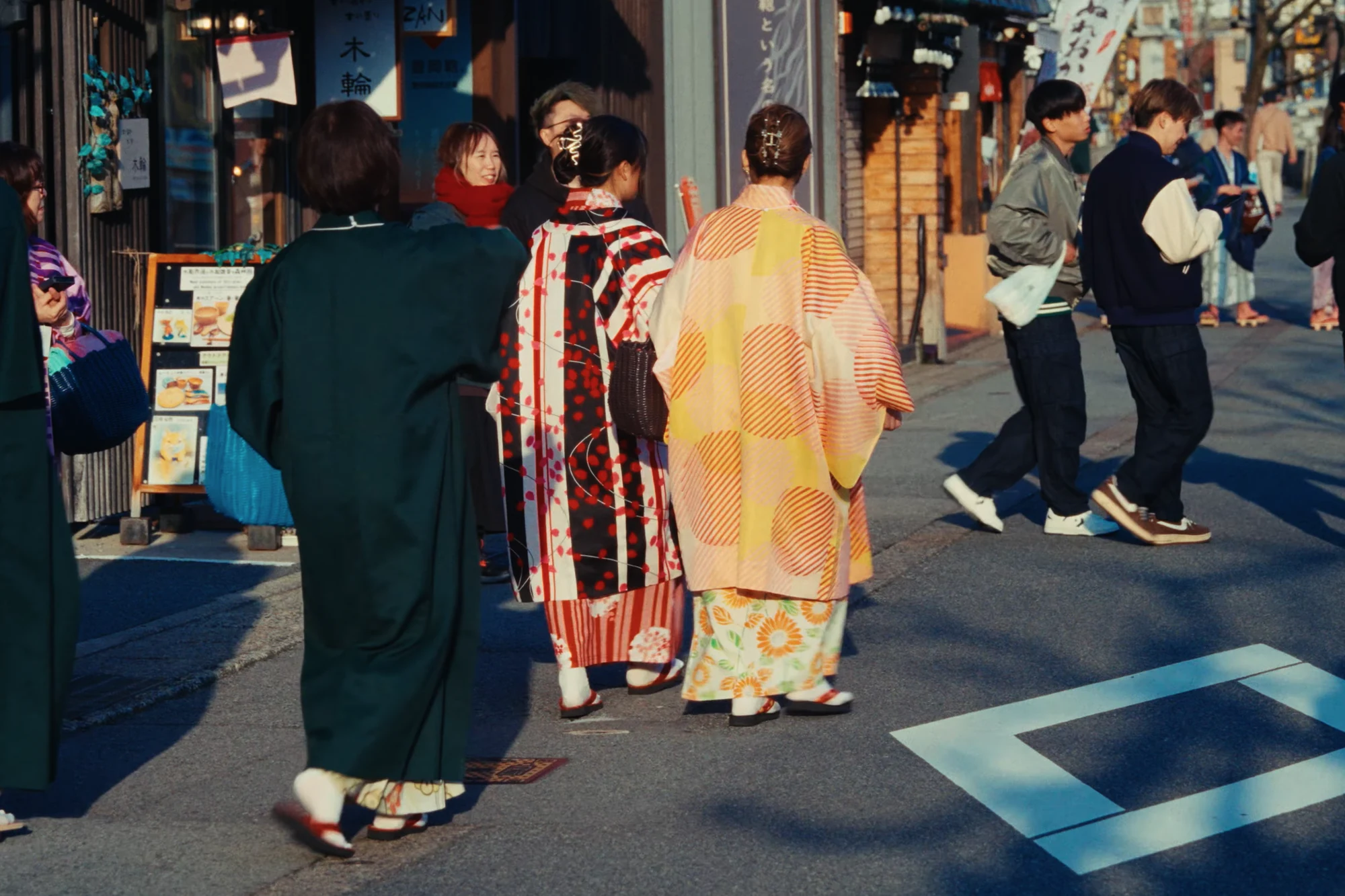
Ordinary underwear underneath is normal and expected. The traditional under-layer exists to protect the garment.
Yukata for men
Men's yukata in Kinosaki tend toward indigo, grey and geometric patterns, and the male version of the dress code is, if anything, easier: collar straight at the neck, obi tied LOW on the hips, below the belly rather than at the waist, with a simple square knot at the front-then-rotated or just off-center. The most common mistakes men make: tying the obi high at the natural waist (it reads as costume), letting the hem ride at mid-calf (ask for a longer size; the hem should reach the ankle), and abandoning the geta for sneakers, which technically no one forbids and everyone notices. Worn correctly, with the jacket in the evening, the men's yukata is the best-dressed a traveler will feel in cotton. Sizing is the detail worth solving early: ryokan stock runs S/M/L and most houses keep longer sizes for taller frames — ask at check-in rather than accepting a mid-shin hem, because length is the single thing that separates dignified from costume. Between sizes, take the longer. And the finishing move nobody mentions: in cool evenings the haori jacket goes over the top, worn open, which reads instantly local and hides a multitude of obi sins. Watches and glasses stay on, the phone rides in the sleeve or the drawstring bag, and the obi doubles as a surprisingly secure holster once tied properly — the garment predates pockets and solved the problem before them. If in doubt at any point, the front-desk demonstration takes sixty seconds and removes every remaining question.
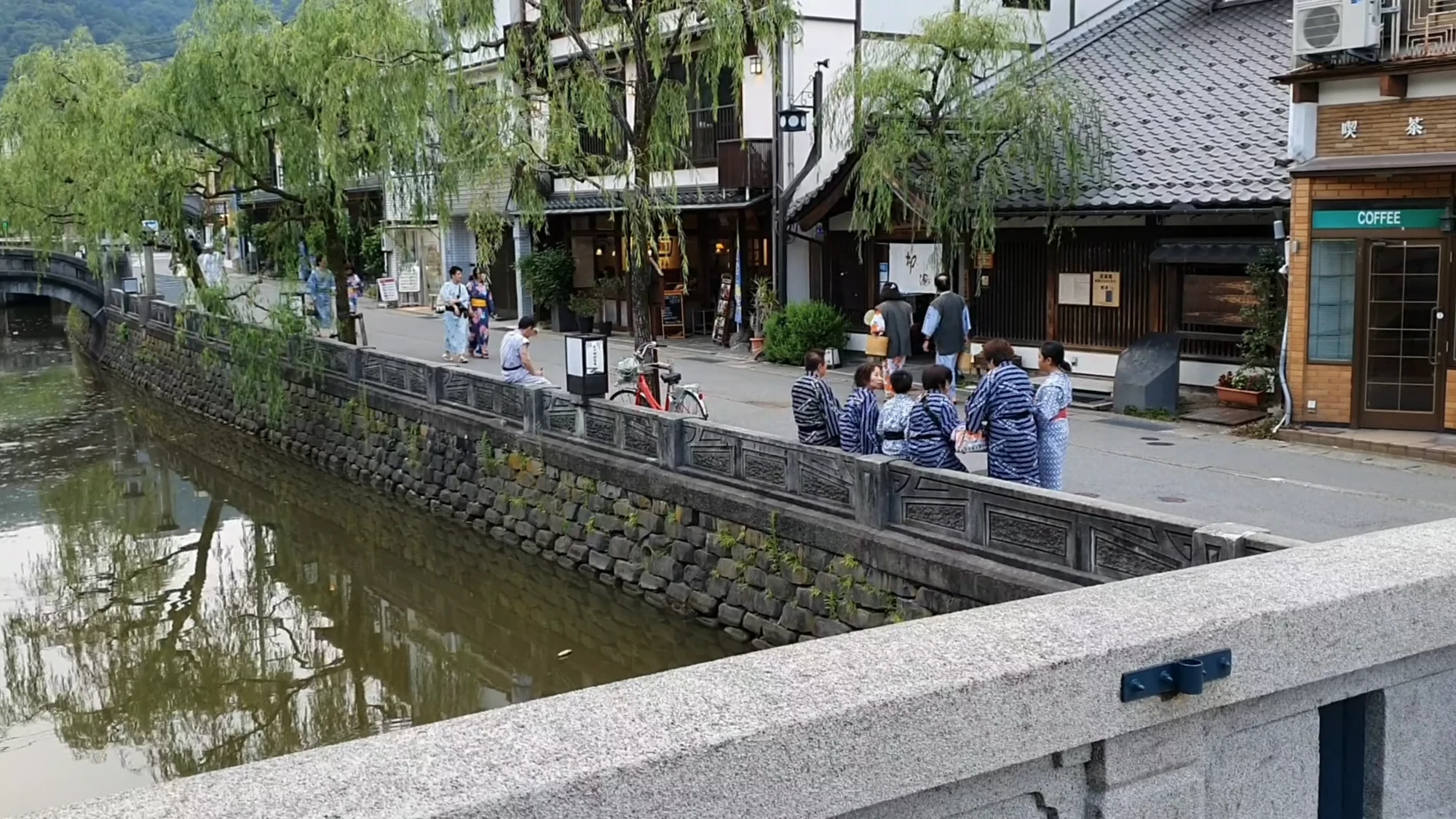
Men's yukata sit lower on the hip, with the obi tied below the waist rather than at it.
Yukata for women
Women's yukata in town run from classic indigo to seasonal florals, and many inns keep a rental upgrade rack of brighter patterns and wider obi for a small fee, with proper dressing help included. ⚠️ verify current rental offerings per inn and the town's rental shops before publish. The functional differences from the men's version: the collar pulled slightly back from the nape, the obi tied higher and often wider, with the decorative knot worn at the back, and an under-layer camisole in cooler months. Hair up is traditional and practical at the baths. For photographs, the canal bridges at dusk, lanterns just lit, are the town's standing portrait studio. Two practical notes for the bath circuit specifically. Choose the simpler obi knot over the decorative one if you are bathing more than twice — it survives seven retyings far better, and the wide festival bow is really for the evening you are strolling rather than soaking. And the upgrade racks reward a look even if you keep the inn's default: patterns differ house by house, dressing help is included, and the difference in photographs at the lantern bridges is real. ⚠️ Rental offerings vary by inn; check at the desk. Hair ties and clips are worth packing even for shorter hair — the baths ask for hair out of the water, the collar sits best with the nape clear, and the inn's kit rarely includes them. It is the single cheapest packing win this particular trip has to offer, and the one most often discovered at the first changing-room mirror.
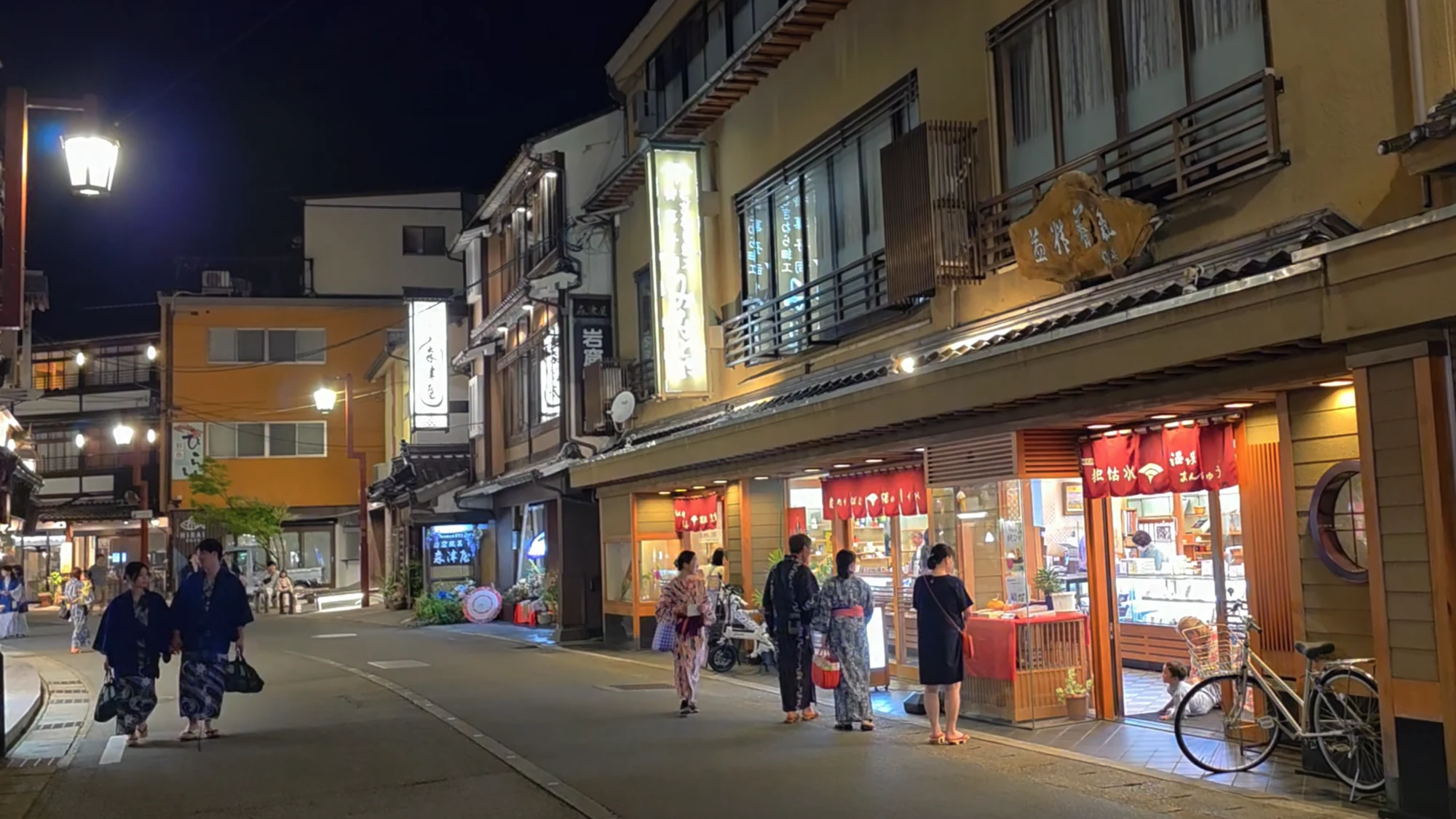
Left panel over right, for everyone. Right over left is how the dead are dressed.
Winter: yes, you still wear it
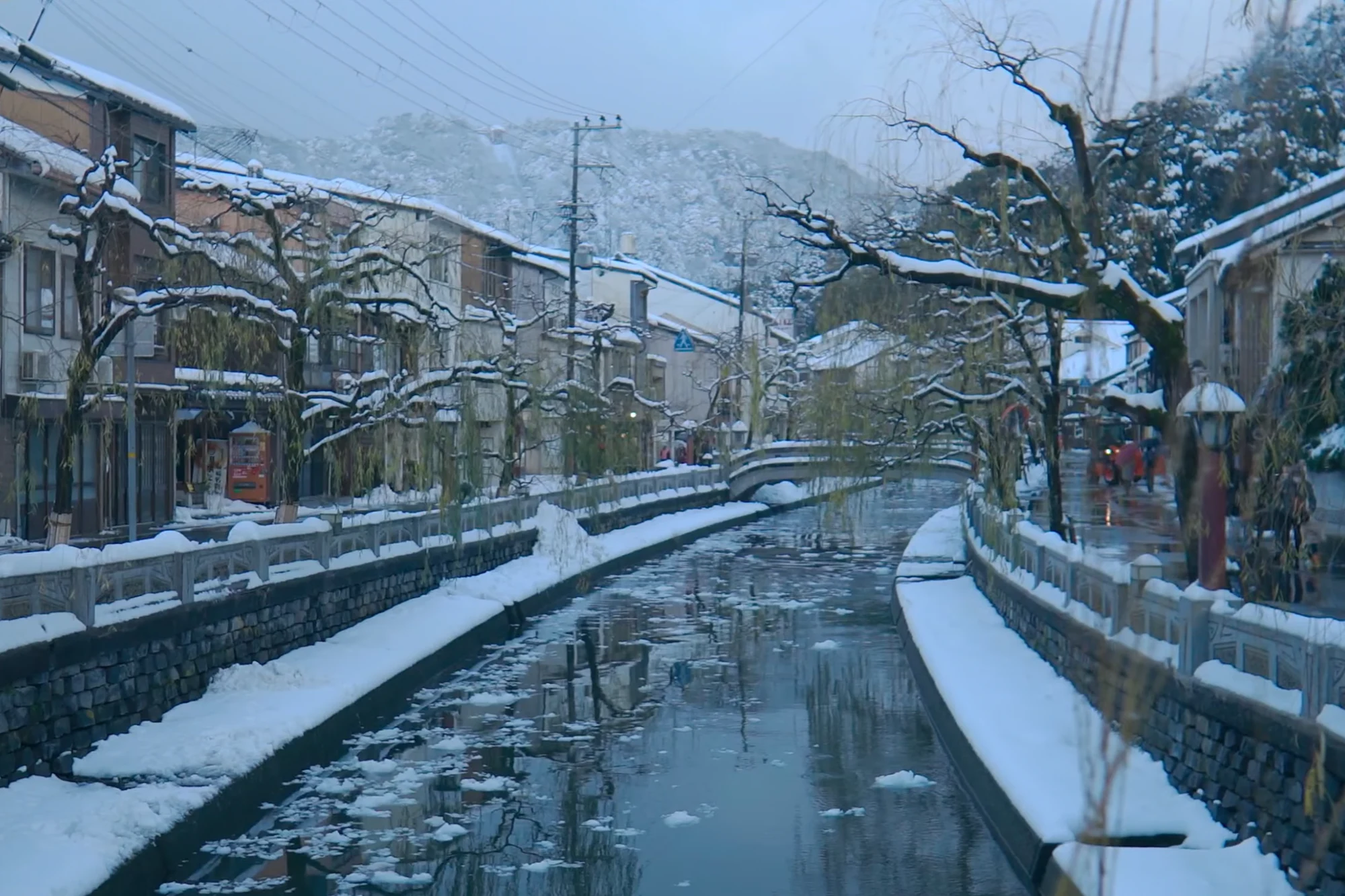
First-timers in January assume the yukata season is over. The town disagrees: winter is peak season, and the kit simply grows. Over the yukata goes the tanzen, the thick padded kimono-coat every inn provides, plus the haori jacket, and suddenly the cotton question disappears; the walk between bathhouses in falling snow, wrapped in a tanzen, is arguably the single best version of the Kinosaki experience. Add the inn's tabi socks with the geta, keep the soaks slightly longer, and let the bathhouses do the heating between stretches of cold. The locals' rhythm in winter is shorter walks, more baths, and nobody is cold for more than four minutes at a time. The physics deserve a sentence, because they convince the skeptical better than reassurance does. Chloride spring water — Kinosaki's type — slows evaporation from the skin, so the heat of each bath genuinely travels with you into the cold; the walk between houses is conducted inside a portable warmth the water itself applied. Layer the 丹前 (tanzen) over the top and the four minutes between doors become the refreshing part rather than the endured part. January guests reliably report the same discovery in the same order: dread, surprise, preference. The tabi question resolves the way everything here does — practically: traditional split-toe tabi work with geta by design, ordinary socks work with geta by determination, and in January the town's position is that warm feet outrank orthodoxy. Pack one warm pair, decide nothing in advance, and make the call on the first bridge of the first cold evening.
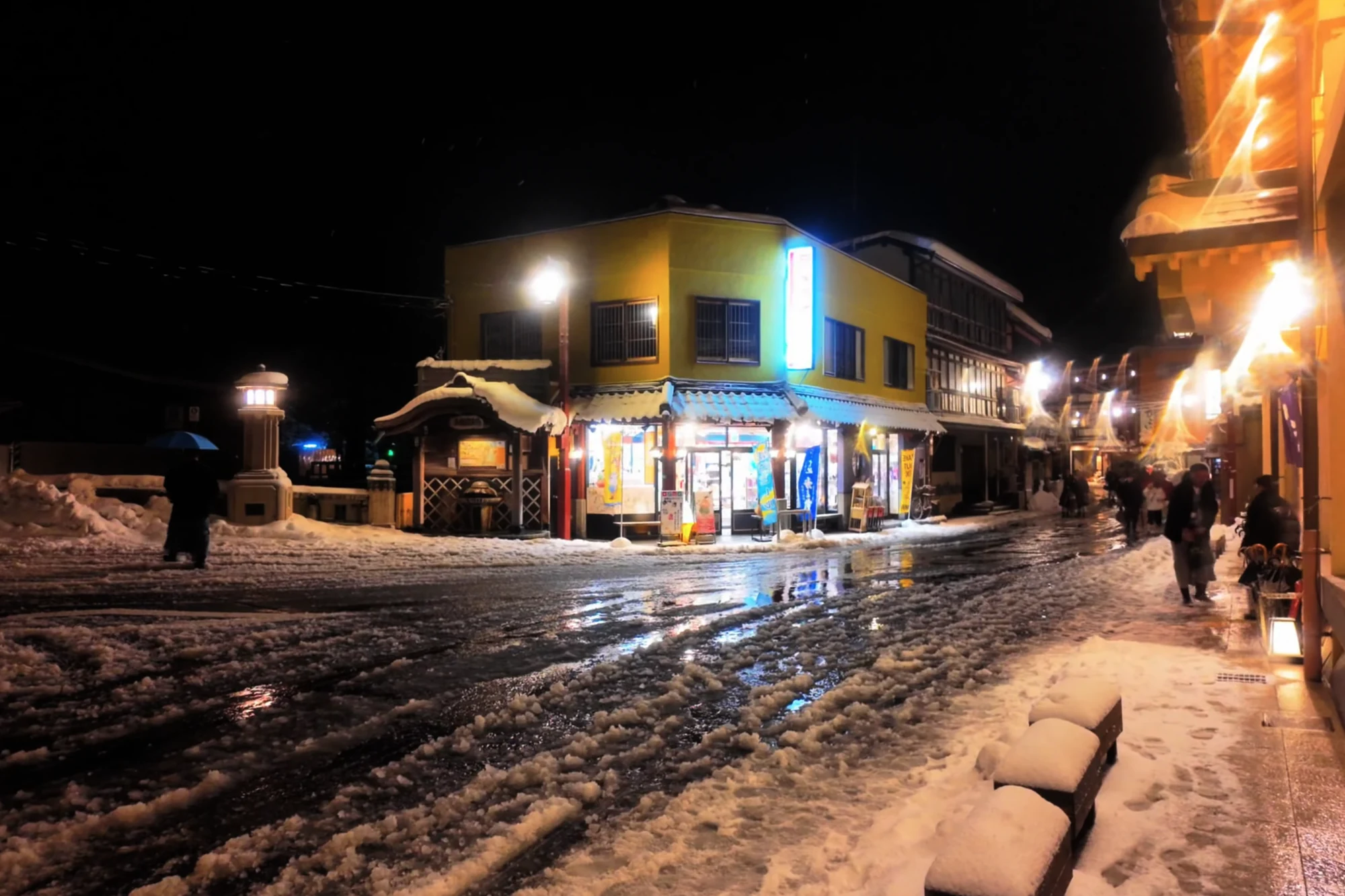
The winter system is a hidden base layer, the yukata, and the tanzen coat — refined by a town that bath-crawls near 0 °C.
Walking in geta, and the etiquette that matters
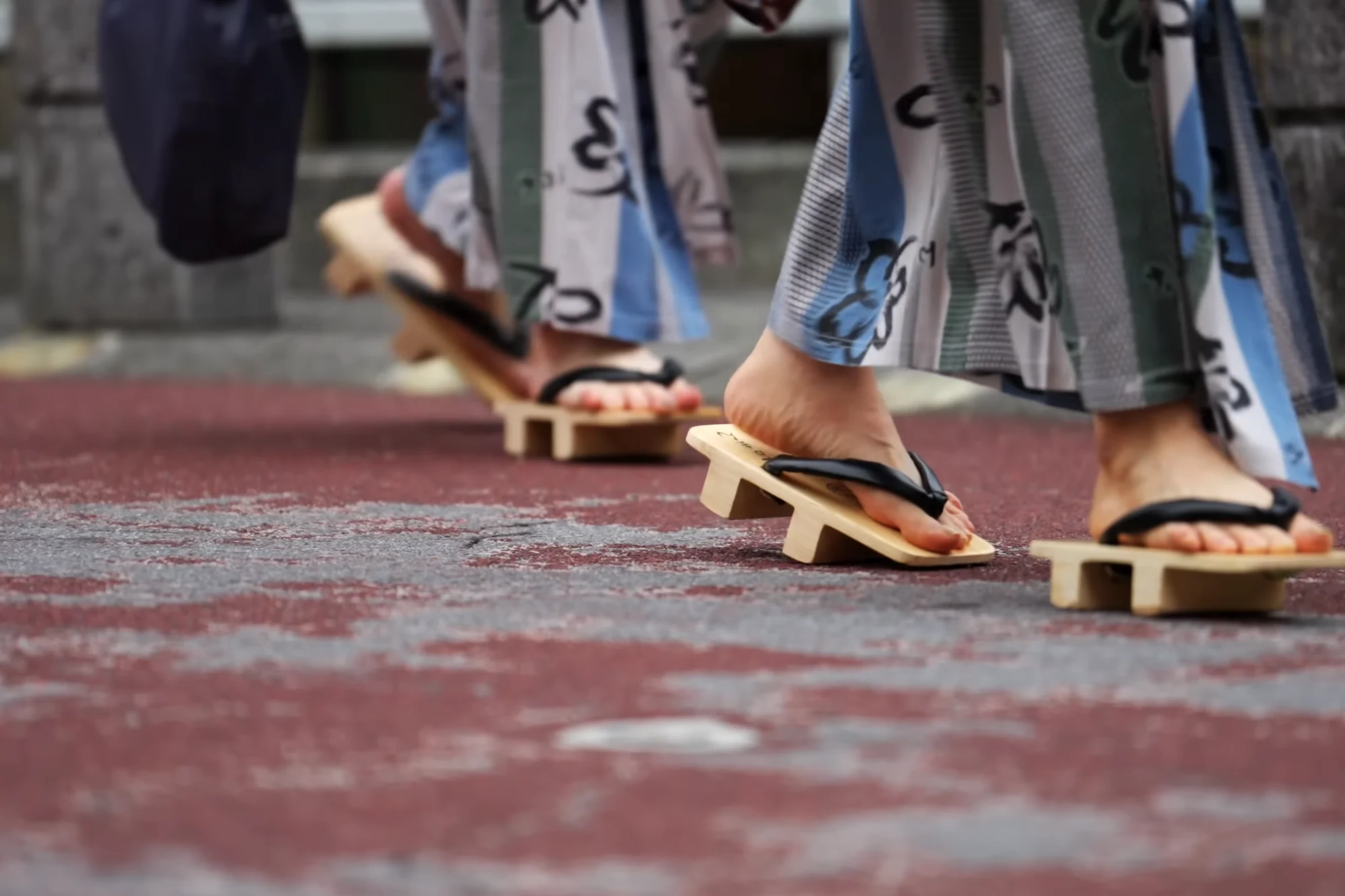
Geta are flat wooden sandals on two crossbars, and the first ten steps feel like a prank. The technique: smaller steps than usual, weight slightly forward, let the heel overhang the back edge a little (this is correct, not a sizing error), and embrace the clatter, which the town considers music. On stairs, sideways helps. If rain slicks the stones, the bathhouse entries all have racks, so barefoot moments are brief. The etiquette is short. Keep the yukata closed and the obi tied in public, retie rather than flap. Carry the inn's small towel and your pass; pockets do not exist, so the obi and sleeves do the work, and most inns lend a small kinchaku drawstring bag. At restaurants, yukata are welcome essentially everywhere in town. And the photographs: take them freely of yourself, ask before aiming at strangers, who are, after all, in their bathrobes. One packing note completes the kit: the obi has no pockets, so the inn's 巾着 (kinchaku, drawstring bag) carries the pass, the phone and the towel — and carrying less is the actual skill. A sizing note: geta run smaller than shoes, and the heel is supposed to overhang the back edge — ask for a larger pair only if your toes hang off the front. Rain changes the calculus more than cold does: wet stone plus wooden soles rewards the smaller steps the technique already taught you, and every bathhouse entry has racks and umbrella stands, so barefoot moments stay brief. By the second evening the clatter stops being a performance and becomes what it is for everyone else on the street: the sound of going to the bath.
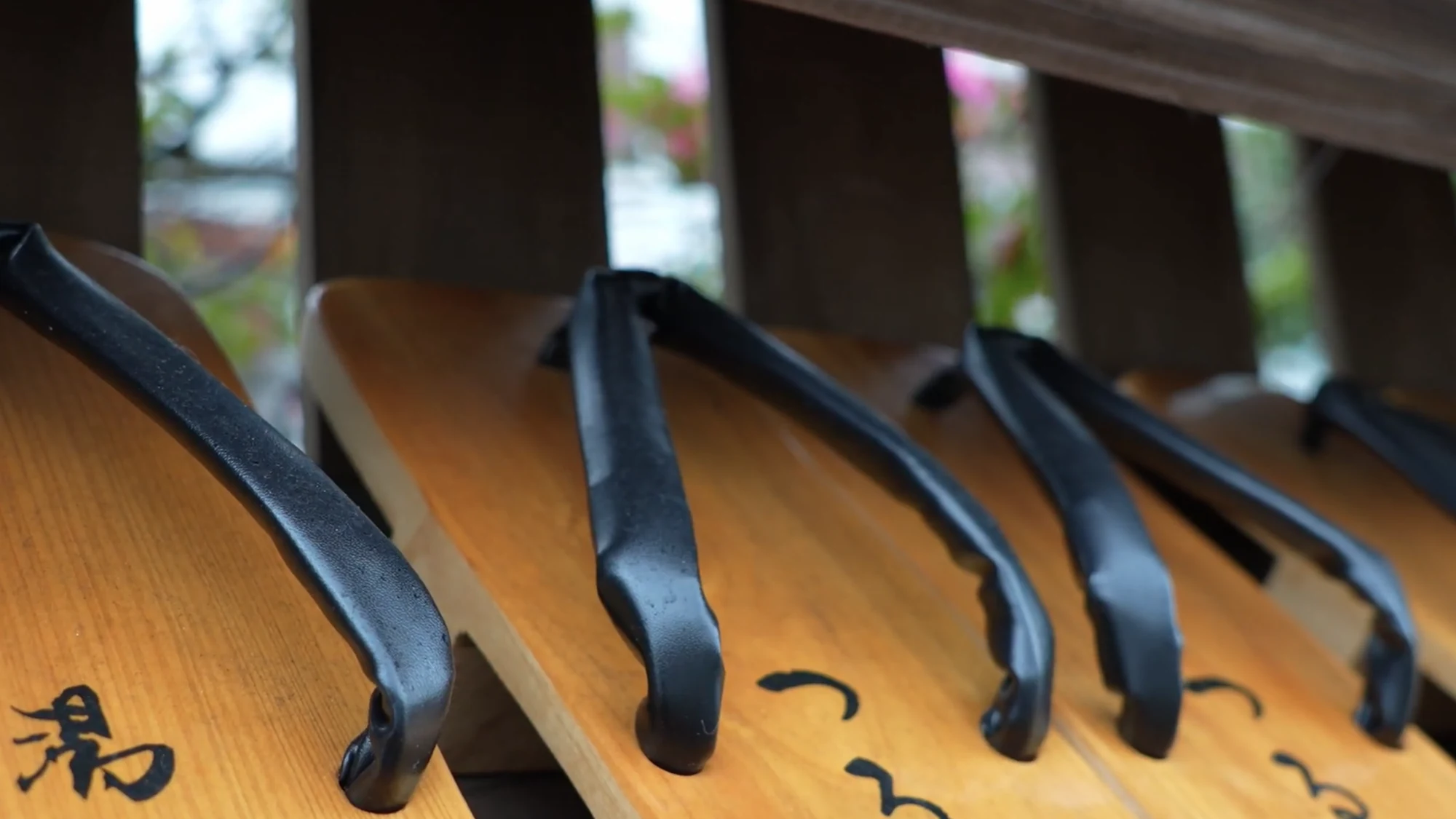
The mark identifies the bathhouse the pair belongs to, which is how a stray pair gets home.
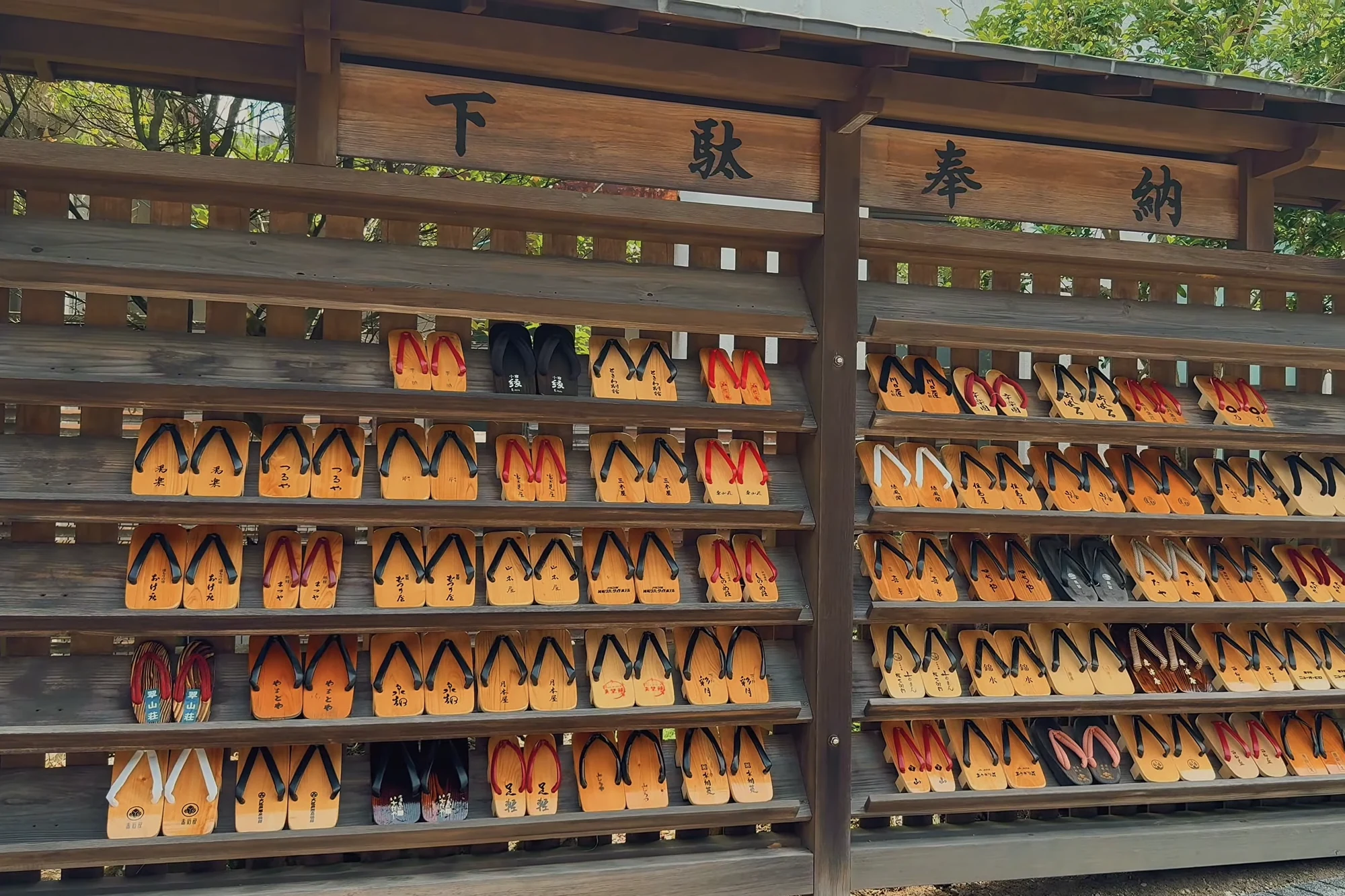
Walk from the heel, let the geta clack, and do not try to move quietly. Nobody else does.
How a bathrobe became a town's street clothes
The yukata's history explains why Kinosaki feels so natural in one. The word itself began as 湯帷子 (yukatabira) — the bathing robe worn in and around the water — and the garment has always belonged to the world of the bath rather than the wardrobe. Most of Japan eventually confined it back indoors: hotel corridors, summer festivals, fireworks nights. Kinosaki never did, because its whole structure kept the bath outdoors — the ordinance that caps inn baths means the town's bathing happens on the street, and the clothing of the bath went with it. So the dress code here is not nostalgia; it is infrastructure. The inns hold racks of sizes because dressing guests is part of the nightly operation. The bathhouses assume yukata because their entire clientele arrives in one. The old saying that geta clatter and yukata sleeves are "the flowers of Kinosaki" is the town describing its own streetscape accurately — on a summer evening the lanes hold hundreds of people in cotton, and the unusual sight is the person in street clothes. For visitors this flips the usual anxiety on its head. Elsewhere in Japan the question is whether you may wear the yukata out; in Kinosaki the question is why you would wear anything else — the town has organised itself so that cotton, an obi and wooden sandals are the most practical possible outfit for the evening it has planned for you. Wear it badly on night one, better by checkout, and take home the one souvenir that is actually a skill.
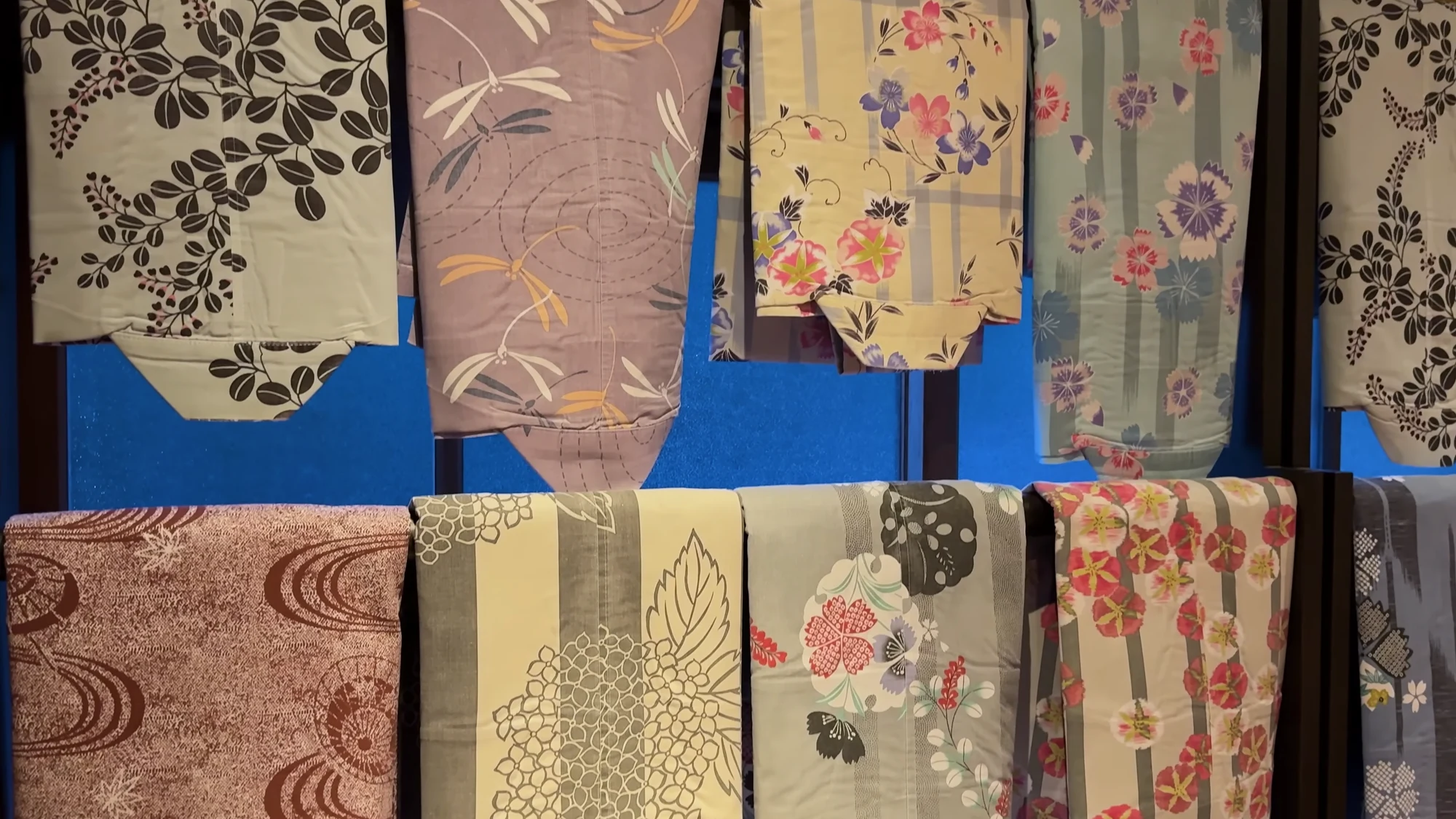
Shops on the main lane sell yukata to take home, generally from around ¥5,000. ⚠️
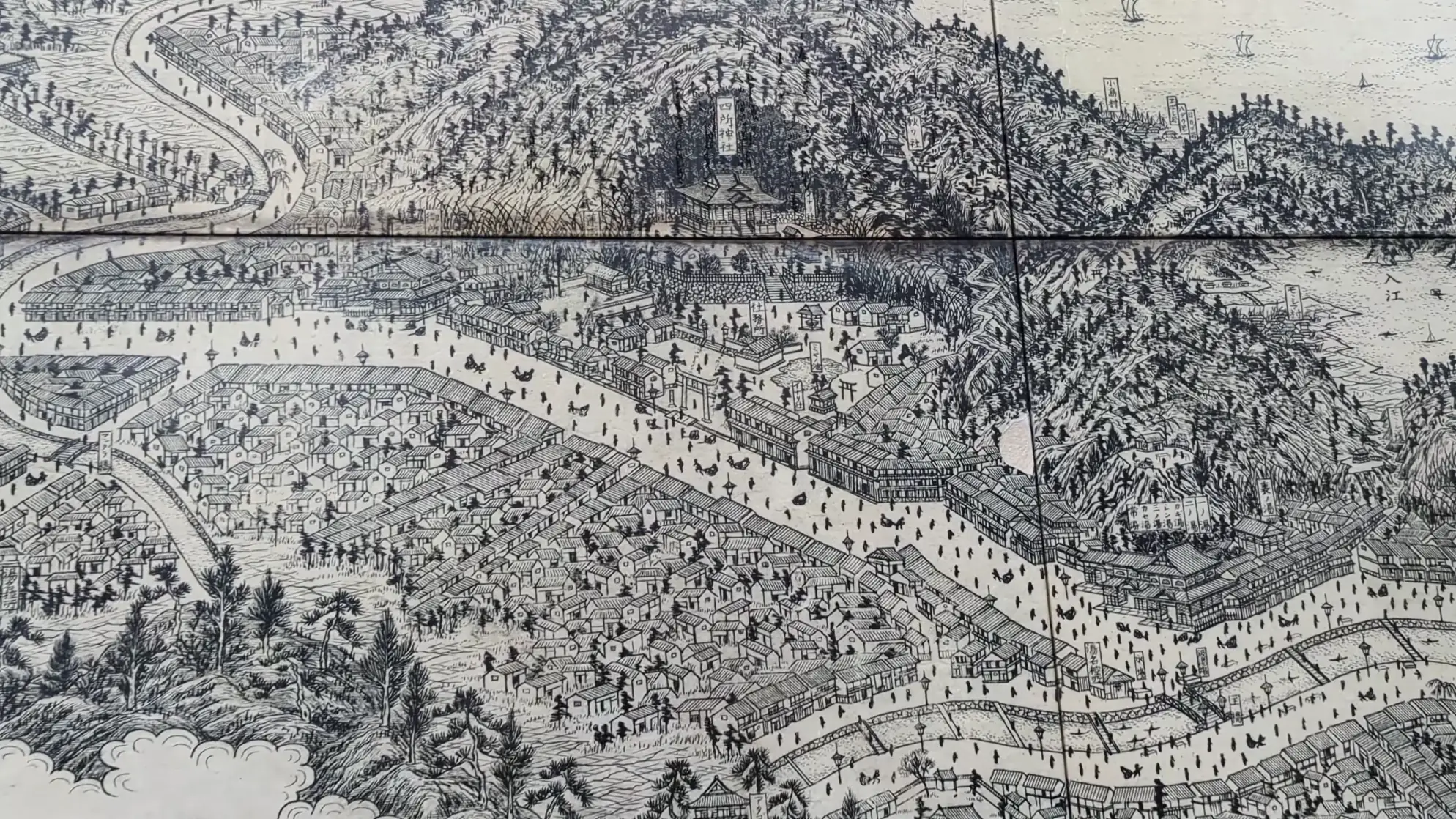
A bathrobe became street clothes because the baths were never indoors to begin with.
Tips
Left over right, always — the one rule everyone will notice if you miss it.
Ask the front desk to dress you; it's a nightly routine at every inn, performed with practiced kindness.
Men: tie the obi LOW on the hips — high at the waist reads as costume.
Winter: layer the tanzen over everything rather than padding underneath; the silhouette stays clean.
Geta technique: smaller steps, weight forward, heel slightly overhanging the back edge — that's correct, not a sizing error.

Verified by The Japan Onsen Society
Show all sources
Drafted June 12, 2026; the ordinance framing and the town's yukata institutions verified September 22, 2026. Primary Japanese sources:
外湯めぐり発祥の地!温泉天国★城崎温泉 — 豊岡市観光公式サイト (Toyooka City Official Tourism Site — the ordinance behind the dress code): [https://toyooka-tourism.com/recommend/onsen/kinosaki_sotoyu/](https://toyooka-tourism.com/recommend/onsen/kinosaki_sotoyu/)
イベント情報 — 城崎温泉観光協会 (Kinosaki Onsen Tourism Association — Miss Yukata contest listing): [https://kinosaki-spa.gr.jp/event/](https://kinosaki-spa.gr.jp/event/)
城崎温泉観光大使 (the association's yukata-branded ambassador site): [https://kinosaki-yukata.com/](https://kinosaki-yukata.com/)
温泉地詳細〔城崎温泉〕 — 日本温泉協会 (Japan Spa Association — chloride spring classification behind the warmth claim): [https://www.spa.or.jp/search_p/detail_p/?F_ID=280880&pg=0](https://www.spa.or.jp/search_p/detail_p/?F_ID=280880&pg=0)
Related guides
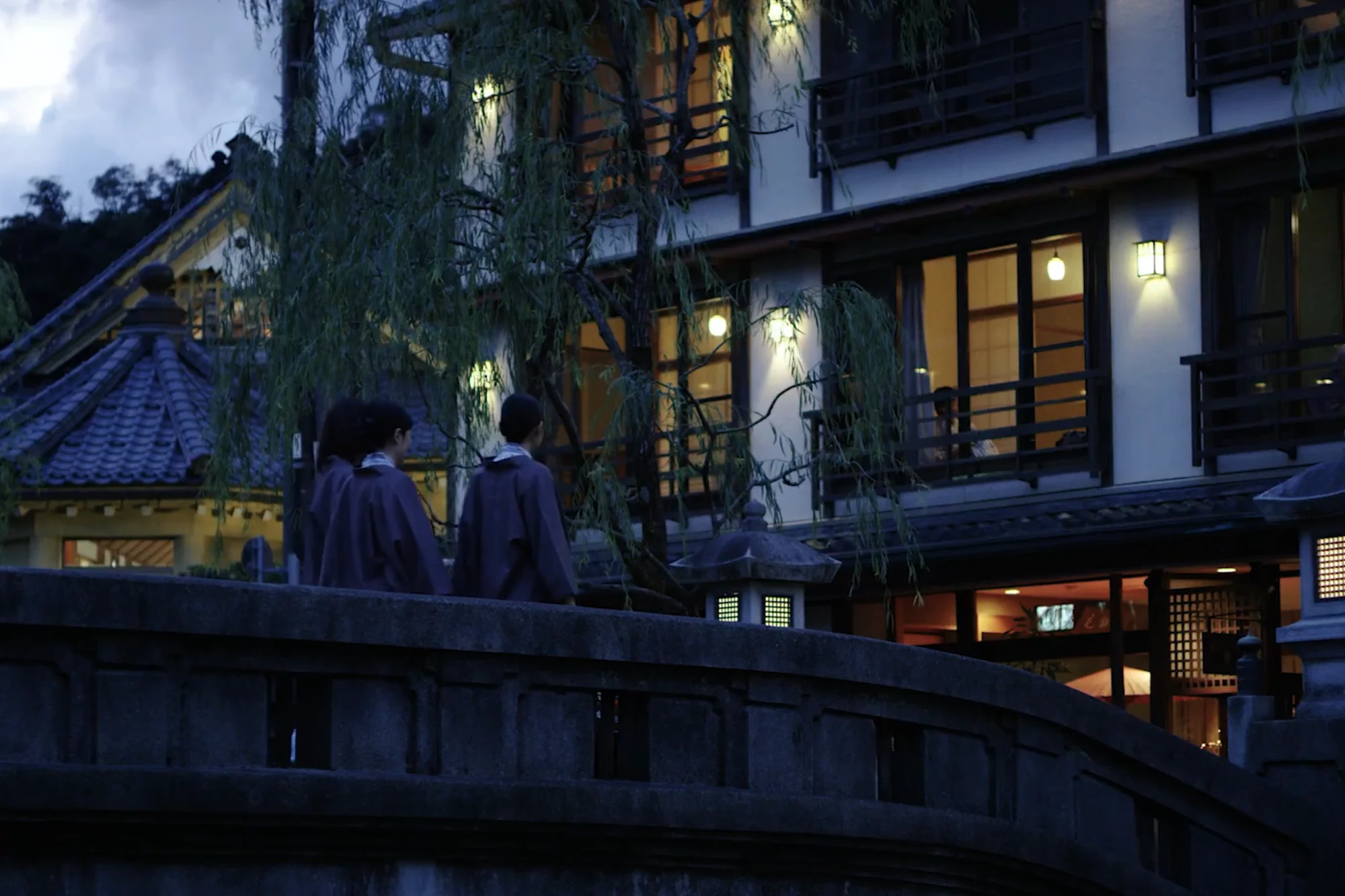
The Town and Its Baths
Kinosaki complete guide
Seven public bathhouses, one shared spring, and a law that keeps them the centre of town. Start here.
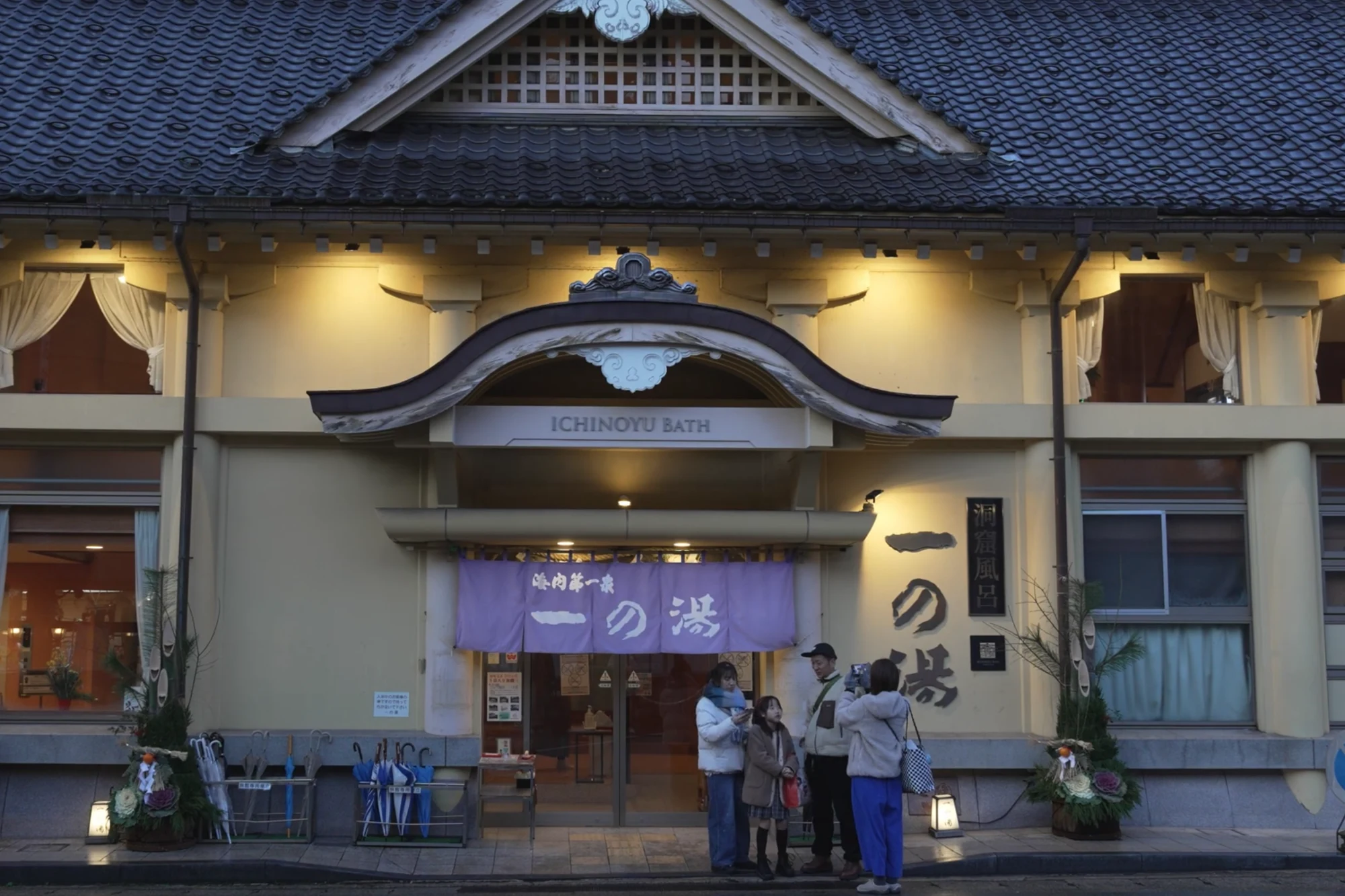
The Town and Its Baths
The 7 bathhouses
Same water in all seven houses. What changes is the room, the story, and the blessing on the door.

The Town and Its Baths
Etiquette
Wash before you get in, keep the small towel out of the water, and nobody will look at you twice.
The Town and Its Baths
Best time to visit
Crab from November, snow in January, willows in April. There is no wrong month, only different ones.